Saturday, March 15, 2025

TEATRO BALANGAW MARINDUQUE, ACT NINE, 2001-02

Act Nine, 2001-02 "BULONG"

AND MOVING ON TO GASAN

Local elections again swept the country in 2001. Newly elected mayor Vicky Lao-Lim of Gasan hired Obligacion who was out of work as her “culture and tourism secretary” (a casual position in the mayor’s office). The Gasan Culture & Arts Foundation (GASCUAF), also headed by the mayor was preparing for a new festival to be held on Easter Sunday. As consultant "GASANG-GASANG FESTIVAL” the name Obligacion had originally proposed to be the name of another festival for August ’02 in connection with the 1st Araw ng Gasan celebration was adopted as the official name of the Easter event.

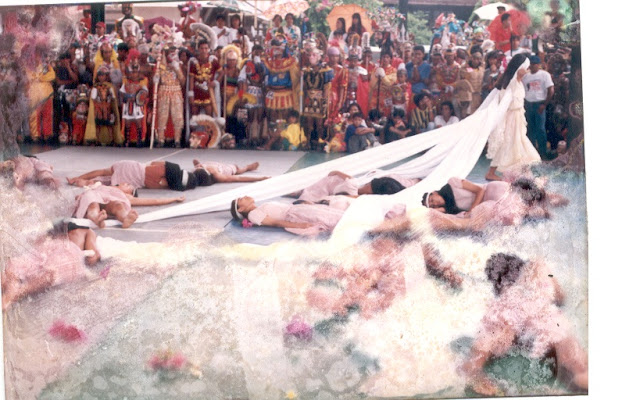
A new theater group was formed by Obligacion for Gasan: ‘TEATRO GASENO’ based in Bangbang National High School. As there was a clamor for such a dance drama. “BULONG” was succesfully premiered with a standing ovation on August 18, 2002 at the still open court beside the municipal office. 

Noted local artist, Raymond C. Go, volunteered to paint the background mural used for the play, a major task and he also did the set design.

“Bulong” was later presented again for visiting tourists as part of ‘Lakbay Aral” tour and for a Christmas presentation in the same town. The lady mayor who was into the arts herself ensured sufficient funds for the project resulting in a “glossy” production that even the NBN-4 TV-crew raved about the dance-drama.
 
Immediately after watching the dance-drama on premiere night, Jan Engels, a Dutch national who has made Gasan his second home, expressed his desire to donate PHP 100,000 half of which should go to the school (Bangbang National High School and half to the Gasan Culture & Arts Foundation to support their culture and arts projects. It was done.

 "I never thought it was possible to come up with something like this in Marinduque!", said Engels. The next day he treated the entire cast and production staff, to a whole-day mountain resort picnic at his tropical paradise.

Throwback on Bulong (boo'-long) Marinduque folklore


A compilation of Marinduque's folklores was published in 1914, annotated by Henry Otley Beyer, an American anthropologist and professor at U.P. He spent most of his adult life teaching Philippine indigenous culture and became known as the Father of Philippine Anthropology.


Beyer's compilation of Marinduque folklores included stories on folk beliefs and cultural practices that prevailed on the island. It was our inspiration for the staging of "Bulong". Pronounced boo'-long (not bu-long' the Tagalog word for 'whisper'). Bulong is defined as the collective name of spirits that transport humans bodily into another place or dimension. Often on this island, old folks have endless stories to tell about them based on personal experiences.

In 2002, this blogger upon request of the mayor of Gasan for assistance in conceptualizing their first "Araw ng Gasan" celebration thought of staging a dance-drama titled 'Bulong' among other events. Belief in the spirit world and ancestral worship was of course, the order of the day when Gasan was 'discovered' by the Spaniards centuries before introduction of Christianity. 


"Bulong", written and directed by this blogger was thus a re-shaping of those traditional stories, presenting bits and pieces of historical data to help today's generation get inspired and to perhaps serve as a vehicle for reflection by those who dwell on this stuff. It has since been presented in all of Marinduque's six municipalities as part of an NCCA-PGM project.

'BULONG' SYNOPSIS:

Teen-aged Salve, catching 'bilabila' (butterflies) finds herself in a half-awake, half dream state and sees strange creatures, the elemental spirits, around her and is at once taken to another world. That's the world of spirits and strange creatures we've all heard about on this island. There she's also brought to a door that leads to the island's prehistory.


Salve encounters 'patianacs' (a kind of scary crow), asuangs, tikbalangs, swaying bamboo trees, duwendes, enkantos.. The elemental Bulong spirits take her to the enkanto until a tug-of-war between the menacing asuangs and friendly spirits ensue, thus saving Salve. The enkantada (known as 'white lady' too), enters and since Salve is a mortal decides to take the girl to the world of those who were once mortals, the world of Salve's ancestors. Here the Katalona of "Mara Unduk" fame is seen still wielding power. Salve becomes witness to the romance and tragedy of the Alon-Baylana-Kidlat (Katutubos), love triangle and its tragic end. She also gets to see the island's Pastores anito for the first time.

Salve sees how intruders from other shores supplanted a new set of beliefs to those of her ancestors by the power of the sword and the cross. As the ancient people cry in protest Salve begins to understand why she was taken there. The elemental spirits free her at last, their mission accomplished.


But the enkanto, so smitten with Salve, gets in the way. He connives with the asuangs and ugly characters for her capture. With no one to save her except herself Salve uses the folk formula to set herself free at last from her new abductors.

(to be continued)

Friday, March 14, 2025

TEATRO BALANGAW MARINDUQUE, Act Eight, 1997

Act Eight, 1997

NEW CHALLENGES RISING.

TAKING THE 'WORLD'!


BALANGAW VIDEO & BOOK PROJECT WITH PETA AND IDEA (NETHERLANDS)

In May 1997 the Philippine Educational Theater Association (PETA’s), contacted Balangaw. PETA is the biggest theater institution in the country with over two decades of experience in developing acting techniques for community-based theater and had produced the biggest names in Philippine theater, movie and television.

Balangaw members underwent training under PETA’s basic integrated theater arts workshop (BITAW) program for five days, culminating in the presentation of “PUTIK SA KARAMIHAN, GINTO SA IILAN”. The project that involved interviews with the Balangaw cast and some of their parents were documented on film by Oceanic Films for showing in European cable-TV under the title “Swapping Stories”.


Facilitators were Ernie Cloma, Dessa Quesada, (both of PETA), and Obligacion.

A book entitled “COMMUNITY THEATER: GLOBAL PERSPECTIVES” by Eugene van Erven (Netherlands), a renowned expert on community theater, was later published. It detailed a case study made on Balangaw (for Philippines) in 1997, together with individual stories of community theaters from five other countries namely Kenya, Australia, Netherlands, U.S., and Costa Rica.

Chapter 1 of the book is devoted on ‘Philippine Community Theater in the 90s and a Case Study on Teatro Balangaw Marinduque


On page 49 of the book, van Erven wrote:

"After the show, Ernie (Cloma) takes the microphone to tell the audience that the play they have seen is the result of a five-day workshop with members of Teatro Balangaw and artist-teachers from PETA and that they dedicate the performance to the people of Marinduque. Melo Miciano, Harold's and Hajun's father, tells me he is proud of his sons and expresses the hope that they will perform the play in other Marinduque communities as well. Several unidentified local environmental activists comment that they equally enjoyed it and that they noticed that a lot of the factual information in the play was new to the audience:

Many people from Boac town have never been up to the barrio. They know about it, generally, but don't seem to care. Looking around me I also noticed how people tuned in to the entertainment elements in the show, but turned off during the more serious parts. But this kind of theater is good; it will draw people's attention, like fish to a bait".

(to be continued)


TEATRO BALANGAW MARINDUQUE, Act Seven, 1997-1998

 Act Seven

'TAKING' THE REGION

It must be recalled that in those years there is no MIMAROPA yet but the group of 11 provinces is known as Southern Tagalog Region.

The Marinduque Office of the Department of Education, Culture & Sports (DECS), approached Obligacion to handle the provincial drama entry to the regional competition on culture & the arts. A revised version of “Mis Lagrimas A Ti”, now retitled “HIMAGSIK NG BUDHI” was brought to San Jose, Batangas for the competition with some 25 actors from MNHS and ICC. Virtusio was tapped to direct the play by Obligacion. 


In the end it was awarded 2nd runner-up. But the champion in ALL the competitions in culture & arts was Batangas.

Meanwhile, the Philippine Independent Church (PIC), in Gasan in cooperation with the municipal government was to handle the “Pugutan” presentation in 1997. The mayor approached Obligacion for assistance in terms of provincial funding and the conduct of the activities. He introduced Virtusio to the mayor and the parish priest recommending him to direct their Holy Week play. PIC commissioned Obligacion to write a new play on the Passion of Christ and the involvement of Longinus. Apparently the Celso Carunungan script introduced in the 70s had been altered many times by whoever organized the annual “Pugutan” and now considered incoherent.

On condition that the “Pugutan” play would not take the place of the Easter Sunday street festival observed in Gasan as was the experience in Boac, Obligacion agreed to write it, in consultation with Fr. Arevalo of PIC who provided some literature. “SA NGALAN NG KATOTOHANAN" (changed to “KASAYSAYAN NI LONGHINO”, without authorization from this playwright), was finished by end of January 1997 in time for the start of rehearsals the following month. 


Curiously, however, the play’s programme drafted by the director was an insult to the playwright (another no-no).

Why? The name of the priest in his capacity as “Katulong sa Produksyon” (Production Assistant), and that of the director in huge letters occupied a wide space on top of the printed page. In small letters somewhere under the names and positions of the production and technical staff was the following entry: “Dialogues by: Eli Obligacion”, referring to the playwright.

A couple of years later the same script, now corrupted, would be presented several times elsewhere in Marinduque by a new playwright: Virtusio.

By this time, the Department of Agrarian Reform (DAR) then sponsored a national competition on theater arts for the promotion of the government’s land reform program. For the regional competition Obligacion accepted the challenge to write and direct a new play based on a storyline provided by DAR and adopted to the local situation. Students of Cawit National High School who were mostly children of farmers and fishermen were the choice as players. They were given a new identity as “BALANGAI PEOPLE’S THEATER”. “ARKO”, Marinduque’s entry was awarded 2nd runner-up (again) in the competition participated in by the region’s eleven (11) provinces. It was held at Imus, Cavite.

It was DAR's turn to cover the expenses.

The winning play was presented in Boac upon the invitation of the municipal government for the celebration of the 3rd anniversary of the Marcopper mining disaster, and for the municipality’s Philippine centennial celebration at the Boac riverside arena.

(to be continued

Thursday, March 13, 2025

TEATRO BALANGAW MARINDUQUE - Act Six, 1995 - 1998

 1995-98 KUNG SAAN-SAAN NA PO NAPUNTA

Provincial competitions in culture and the arts (on-the-spot painting, choral competitions, sabayang bigkasan, essay-writing, folk and modern dance competitions, kundiman contests, band and lyre competitions), were initiated by Obligacion as official projects, new festivals organized and traditional ones were revitalized (“Tubungan Festival, “Kalutangan”, “Moryonan”, “Moro Moro” in Mogpog, “Pugutan” in Gasan, “Freedom Run”).

Provincial participation in regional and national cultural events were ensured (“Southern Tagalog Festival”, “Travelmart”, “Rizal Park Independence Day Celebration”)  - all of these were participated in by Marinduque province. It also played host to Southern Tagalog Kundiman Fiesta” and the Daupan Ii Festival for the Centennial of Philippine Revolution, held in Gasan.

Balangaw’s “Mara Unduk” dance-drama was kept alive and constantly improved with new dancers and actors joining the ever-changing faces of chorus dancers.

The Philippine Rural Reconstruction Movement (PRRM) commissioned Obligacion for a play about local heroes to be presented at the DAUPAN II Festival for the Centennial of Philippine Revolution. “MIS LAGRIMAS A TI” (My Tears to Thee), based on the revolutionary exploits of Herminigildo Flores, Remigio Medina, Cayetano Vida (“Alapaap”, and Maximo Abad, was completed and premiered at Gasan’s covered court. The audience consisted of festival participants from all over the country. Students of Immaculate Conception College (ICC) went through auditions for the various roles. PETA’s Jonjon Tuazon directed the play.

At the Southern Tagalog Kundiman Fiesta (ICC, BOAC), presented was Mara Unduk
At the Daupan II Festival for the Centennial of Philippine Revolution. (Gasan), Mara Unduk also enthralled the audience from all over the country.


,

In 1997 the actors and
 singers of Balangaw contributed their talents for the Pulang Lupa celebration
(a reenactment of the battle).

(to be continued)

Wednesday, March 12, 2025

TEATRO BALANGAW MARINDUQUE - Act Five, 1995 - 1996

1995 - 1996 NEW MARA UNDUK HAD 30 PERFORMANCES!!

After watching a performance at Travelmart (SM Manila), of Iloilo’s Dagyaw” and a dance-drama performed by the Leyte Dance Company group of Jess de Paz, Obligacion and Mariposque agreed that it was not impossible at all for Balangaw to come up with a similar winner

“Mara Unduk” could be presented with fresh ideas so that the group was ready with a material it could bring anywhere outside Marinduque, right?

It was evident, however, that the group could not take any chance with another “hoy, tama na ‘yan!” novelty.

The verbal exchange that eventually happened was between the founder of Balangaw and Mandia this time. The latter strongly opposed the idea of staging a new Mara Unduk though he was preoccupied with work in Manila and couldn't do it..

After a long, heated discussion that lasted from night till morning it was setttled. They were long-time friends yet the standing rule must now be upheld: “Nobody is indispensable in theater”.

“Who is going to direct it? Who is going to choreograph it?”, Mandia asked.

“I am in charge. They will be found!”


A Mara Unduk performance at Boac Town Plaza

Roni Abario of Or. Mindoro, a stage actor who also worked as dubbing supervisor at ABS-CBN like Mandia was welcomed by Eli and Rudi to the Balangaw home.

“Tinanong ako ni Danny kung paano ko gagawin ang mga sayaw ng Mara Unduk. Nakita ko ang video nung ginawa niya na hindi ko maintindihan. Ang sabi ko lang, ‘basta mas maganda diyan’!” Roni said.


"MARA UNDUK” became Balangaw’s biggest winner in those days. This collaborative work among Abario, Mariposque and Obligacion was good for over 30 performances in Boac and Gasan. Within one year, invitational performances at Nayong Pilipino, Museong Pambata Finally, Raha Sulaiman Theater for the Philippine Educational Theater Association's National Youth Theater Festival became the happiest performances of 
Mara Unduk.

That's a lot of work. No one gets paid for his or her work at sila pa pong lahat ang gumagastos sa lahat ng needs. Maraming nagbibigay ng makakaya nila to which we are all grateful for.

Sa totoo lang!


(to be continued)

Tuesday, March 11, 2025

TEATRO BALANGAW MARINDUQUE, Act Four, 1995

GUEST DIRECTOR INVITED

In March 1995, Gil Virtusio who hailed from Batangas but he had joined the ‘93 “Moryonan” production as an actor came to Bahaghari unexpectedly. He thought that with a few weeks to Ash Wednesday, Balangaw was in the middle of a new “Moryonan” play.

“But you did not present anything for Holy Week last year!”, he argued, “and this would be the second year in a row now...”

“Are you willing to direct a play this time?”, Eli asked.

“You write a new script!”, was Gil's daring answer.

“Who will be our actors? School’s over! Many are vacationing in Manila. And we have no money!”, that was Rudy.

“Let’s go to town!”, Eli proposed. (The available cast would surelybe there.


“MORYONAN: IKALAWANG YUGTO” was being written by Obligacion page by page while daily rehearsals were going on. The students, mostly living at the town center were only too happy to join since school was over. It was clear that the project would be an exercise in ‘focus and determination’. for us.

No money for costumes, meals and snacks, lights and sound. Even the venue was a problem. The covered court was blocked for political speeches. The election campaign period had commenced.

But old costumes could still be used, there could be some supporters and friends who could provide snacks, bamboo torches, lots of them, could be used in place of stage lights, a dried up circular fountain in front of the Rizal monument (opposite the covered court), measuring four (4) meters in diameter - and the area around it - could serve as the acting area. Theatre in the round!

At dress-tech, the bamboo torches were extinguished by the summer wind one after another, voices were completely drowned out by the blaring political speeches from right across. In just 10 minutes all the torches were out, the final rehearsal went on illuminated only by street lights and the moon. At the end of the rehearsal the actors were completely quiet staring at the floor. They were ready to uphold the “show must go on” tradition in theater but only if they could be seen by the audience.

“Yes, we will find a way. We will have lights and sound by tomorrow!”, Obligacion said with muffled voice.

Michael Seno who was acting as campaign leader for Bong Carrion accidentally passed by and came to the rescue. The mobile system they used for the campaign was available the next day and he would only be too happy to allow us to use it, gratis. Rico Sanchez offered to also provide soft drinks and snacks for the cast.

RECORD TIME

The play was done in record 10 days from the writing of its script to premiere night. “MORYONAN: IKALAWANG YUGTO” was the first production of Balangaw that had a re-run in Boac, brought to Gasan and Mogpog before a jampacked audience. For these free shows support came in for coverage of lights and sound, transportation, meals and snacks. The costumes and props improved. Mostly students from Immaculate Conception College and a few studying in Manila who had returned for vacation were among the cast. 

Gil’s two Filipino friends from “Migrante” in Hongkong came to lend a hand in the production of the Boac re-run.

Mandia who was pre-occupied in Manila with his own affairs came, protested the assignment of Virtusio as guest director, during a visit, argued that he had the right to stop the performances as “artistic director of Balangaw” finding imagined defects in a play that had been premiered successfully and shown in two towns outside Boac. The “I am the God of theater in Marinduque” and “I am the Messiah” lines were thickening the Bahaghari air (my place) this time. Quotes like that are, of course, a dime a dozen in this country but really, it was just all about who was the better director between the two.

“Him with his stage managing and masteral degree that he has yet to earn, and me with my experiences and all the books I’ve read, yes, let us have a debate on theater directing!”, a forceful Virtusio argued.

But it was not hard to see who between the two would pass off as the better director, one who knew his art better and religiously practiced the basic: understanding the material at hand.

As ‘hermano’ again for the Lupac barangay fiesta on June 1, Mandia and Montenegro had a talk in Manila. The latter wanted “IKALAWANG YUGTO” presented in Lupac to entertain the community on the eve of fiesta with Mandia as director this time. The company director /playwright acquiesced. With the exception of a couple of actors who had acted in “Ikalawa…”, the new group trained by Virtusio were utilized for the now-controversial play.

So much for that.

(to be continued)


TEATRO BALANGAW MARINDUQUE - Act Three


Benjie as hermano also introduced the first boat race in Lupac in 19994, together with  Sto. Nino de Pescador as Patron Saint.

Christmas 1993 and Holy Week 1994 came to pass, the group slumbered. In May Montenegro as ‘hermano’ in Lupac proposed a play production. Mandia came with ready scripts by ‘anonymous’ authors of two fairly well-known comedy plays popular in city schools: “Manggagahasa Kami sa Isang Linggo”, and “Bakit Babae ang Naghuhugas ng Pinggan”. Stage actors/dubbers of cartoon programs who worked with Mandia arrived with him to act out the roles for the first play. The second was to be performed by selected local talents.

“Manggagahasa..” was a total disaster. The classic “Hoy! Tama na ‘Yan” (Hey! enough of that!") polluted the air again, the audience made no effort to hide their disinterest, such that the actors were too embarrassed to take center stage for the final bow. The second comedy with characters that looked like they came straight from comic books managed to elicite laughter from the slapstick comedy. A good ‘workshop’ exercise. But then we are supposed as a general rule to present only plays with Marinduque content. Nothing more, nothing less.

 SADLY, NO MORE ELI PLAYS FOR MANDIA.

It was evident that for some theater practitioners, for as long as a play is presented to an audience, that could already be considered success (“basta naipalabas!”). It had nothing to do with whether or not they understood it. But the rest of Balangaw disagreed with that crazy concept. We had not existed to serve somebody's bloated ego and grand illusions of one being 'god of theater', a phrase off and on repeated before the young talents to establish artistic authority.

Came June, Obligacion proposed to Balangaw trustee, Rudy Mariposque (a.k.a. Rudi Mariposky), to take up the challenge of directing a new play this time whose only aim (to drive home a point) was to draw from the audience “a long and rousing applause”.
The only goal aside from the usual.

The answer: 

“Only if no one will claim credit for my artistic directing!”, he demanded. The simple deal was closed

MARIPOSQUE AS ARTISTIC DIRECTOR.

“ISANG ARAW SA HISTORY” (PAYE IN RETROSPECT) by Obligacion came into being. The play had a campus and classroom setting. The main protagonists were high-school students and their teacher in History subject. The students were asked to write individual essays on “What the Battle of Paye Means to Me”. The inconsistencies in certain claims and unlikelihood of such a ‘battle’ occurring in Sitio Paye, Balimbing during the Filipino-American war were each laid bare by the students before their alcoholic History teacher. He was the principal researcher/historian on the subject, and the students just came short of accusing him of ‘historical and journalistic dishonesty’. Musical excerpts from “Labanan sa Paye” the previous year were also utilized to break the scenes.

The covered plaza was surprisingly filled with people who came towatch. Boy and Girl Scouts from all over the province who were encamped at the Paye site were brought by trucks hired by their organizations to watch the play. The receptive audience applauded at every scene. Then, at the curtain call the biggest came like a thunder: “the long, rousing applause!”. So startled was Rudy, the audience wouldn’t stop cheering that he ran to Eli asking: “What are we supposed to do now?”

“Well, you have to say something, probably introduce every single player this time?” The applause was louder when he did. Then the group learned, and everyone involved felt strongly what “critical acclaim” meant - for the very first time!

“Eli, nangyari ‘yung gusto mo!”, an ecstatic Dindo Asuncion who arranged the music and took care of the lights said running to me.

Later the Sangguniang Bayan of Boac had a deliberation on the Paye controversy presented in the play and formed a “fact-finding committee” to ferret out the truth. It, however, seemed natural for such a committee to die a natural death. Politics hahaha!

(To be continued)

Note to Teatro members: I have ran out of photos to include in this 'teleserye'. Baka naman may inatago kayo diyan please.

Sunday, March 9, 2025

TEATRO BALANGAW MARINDUQUE Act Two (cont'd) - 1993

MORYONAN NA!

April 1993, the Balangaw group made its debut in the Boac riverside area on a makeshift stage built for the purpose (provincial authorities refused to allow the use of an existing concrete stage just meters away known as Palacio de Moriones, as it "might be destroyed by the children").

Morion mask from 1972 Philippine Airlines (PAL) magazine cover.

MORYONAN: ISANG BALIK TANAW” the intended play to be presented only once, also written by Obligacion, and directed by Mandia, was an attempt to trace the evolution of the Moriones from pre-Hispanic rituals to contemporary times. The play was presented (after unsuccessful overtures from certain leaders and politically-inspired groups to prevent it from being shown, something that surprised us, the group). It was merely intended  to revive an age-old tradition of staging a street-event at Lent’s culmination.

The play was to be preceded by a moryon mask-and-costume street-parade that the young people - some 500 youth participants and some volunteer old folks who later read excerpts from “Pabasa”. Prizes donated solely by Montenegro were to be given to winning costumes and groups. National papers and television took notice.

Balangaw constructed a makeshift stage nearby as if to make the message that no one has the right to prevent Teatro Balangaw from presenting a youth-oriented fun-play that promotes creativity and unity among participants. In the middle of the noonday heat was a mammoth crowd that came to watch. The Manila Times was there to make their own coverage of this event.

By July 1993 the group was ready with “LABANAN SA PAYE (A MUSICAL), written by Obligacion. The material was based on actual stories and events that revolved around the character of Teofilo Roque, the ‘Battle of Paye’ hero. Fifteen (15) songs were composed (both lyrics and music), by Obligacion in the kundiman, balitaw and contemporary style, with keyboard musical arrangements done by Dindo Asuncion. Performers were from the Marinduque National High School with guest young artists from the Immaculate Conception College. Directed by Mandia and was performed at the Boac Covered Court from 7.00 pm on the day of the battle.

It was to be tbe turning point. The cooperation of the Municipality of Boac was formally obtained but exclusive only to use of the public venues, without funds solicited. A souvenir program with a message from the Mayor was readied by Obligacion with Montenegro agreeing to sponsor its publication.
 
It was to highlight the municipality’s role in spearheading the Battle of Paye celebration consisting of various activities, the play being only one of them.

In an effort to avoid any further misunderstanding with the municipal authorities, a final draft of the program was readied. The play’s director, who was in Manila where the program was to see print. However, last-minute alterations on the cover-page gave a terribly wrong impression that caused an uproar. It omitted the participation of the municipal government who spearheaded the activities.

Worse, the Balangaw production page was likewise altered that billed the director, as also the scriptwriter.

As a result, the municipality umderstandably did not distribute the hundreds of program copies arriving one day before the presentation. “Mali!”, was the only word they could come up with. Consequently, no one from the municipio came to watch the free show and with the exception of curious passers-by and a few supporters the actors performed in a practically empty hall.

It was the period of reflection and re-examination of conscience by all the Marinduque-based members of the group.

(to be continued)


Saturday, March 8, 2025

TEATRO BALANGAW MARINDUQUE, Act One -1992-1993

 Act One: 1992-1993

My old house, new at that time

Prologue

Life was boring in Marinduque in those days. No entertaiment, no nothing except morions come Semana Santa and the familiar putong. But I have decided to live here after years in Manila that by October in1992, TEATRO BALANGAW was founded by Eli Obligacion (yours truly) and a small group of colleagues from Boac, Marinduque who supported the idea that a community theater could be a good venue to promote interest in local culture, showcase the untapped talents of young people and present issues affecting the community. 

Two months later, its initial project was presented at the Boac Covered Court for the town fiesta celebration. The home of Obligacion in ‘Bahaghari’, Amoingon beach served as Balangaw’s permanent headquarters, rain or shine or any sort of delubyo.

Act One: 1992-1993

OBLIGACION AS COMPANY DIRECTOR/PLAYWRIGHT;
MANDIA AND MONTENEGRO AS ARTISTIC DIRECTORS.

The first production was a ‘double presentation’ basically sponsored by Benjie Montenegro of Lupac who owned BM Talent Pool, a promotions company based in Manila. BM came in full force with his talents for “PISTAHAN NG SAYAW AT MUSIKA” a dance revue featuring jazz, modern dance, and cabaret with solo numbers performed by notable artists from Manila. Montenegro handled the over-all concept, design and direction of “Pistahan”.

Obligacion’s “MARA UNDUK” (A Dance-Drama), was presented as the ‘local’ project with 52 students of Marinduque National High School. Danilo Mandia of Boton was its director. Improvisational movements were utilized for the play that lasted for 1 ½ hours with non-stop ethnic music (from Muslim to Igorot) as background. Shouts of “hoy, tama na ‘yan!” from the audience, audible even on the video copy is probably its most realistic critique. 

But in reality they just wanted to see the Manila show of fabulous costumes with dancers having agood time in the Land of the Rising Sun.The audience also apparently had a hard time understanding what was going on onstage with Mara Unduk which was shown first.

“Wagi! Wagi ako!”, were the words of Mandia of theara Unduk play, “Nailabas!.. " 

(“It isn’t art, but I have their attention.” – The Chorus).

My very first musical composition was sung as the play's theme  song (by Ian Venida who later ended up among the cast of Miss Saigon on Broadway)

But the old, historical Boac Plaza was filled to capacity alright with folks from all over Boac and never mind the monsoon rain that was expected anyway.

(to be continued)