Showing posts with label PASTORES. Show all posts

Friday, July 28, 2023

From 'My Ancient Marinduque' to Wiki's Prehistory of Marinduque

 This is one of the earliest articles I've written and posted in this blog in 2009  about precolonial Marinduque. It was followed by numerous posts in years that followed that eventually an entry was included in Wikipedia titled PREHISTORY OF MARINDUQUE. Which other provinces or places in the Philippines have been accorded that distinction by Wiki, incidentally? Mukhang wala, nada. And the subject is continuously updated.

The pursuit for cultural discovery in Marinduque continues that many more discoveries have been unearthed since then.
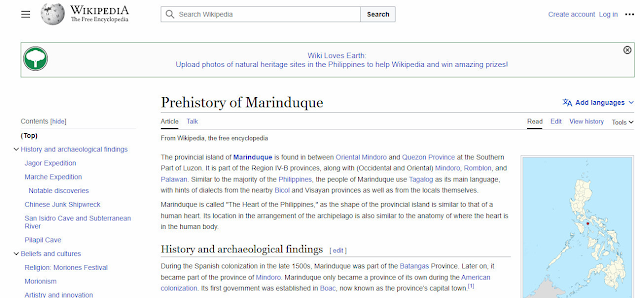


This writer and this website cited as a source.

My Ancient Marinduque

The beginnings of archaeology in the Philippines began right here in Marinduque.
Prior to 1900, only one important archaeological investigation had been carried out in the country: Alfred Marche’s exploration of Marinduque from April to July 1881. While many other accidental finds have been recorded from time to time, and a few burial caves and sites had been casually explored by European or local scientists, no systematic work had been done anywhere else prior to these explorations. After Marche, the next important archaeological work was undertaken by Dr. Carl Gunthe in the Central Visayan Islands in 1922.(Beyer)

"An abundant yield of Chinese urns, vases, gold ornaments, skulls and other ornaments of pre-Spanish origin,” was what the Marche finds represented. He brought back to France in 40 crates the Marinduque artifacts he uncovered. Part of it now said to be housed at the Musee de l’Homme in France. (Solheim). The finds also included wooden images of the Marinduque anito called ‘Pastores’ by the natives.

Part of these artifacts have also found their way into the Smithsonian Institution in Washington, D.C. “Imagine these fragile jarlets traveling from China to the pre-colonial Philippines. Buried in a cave in Marinduque for centuries, they were excavated in the late 19th century, brought to Paris and eventually ended up in a museum bodega outside Washington, D.C. Part of our history lies in museums abroad and it will take sometime to analyze these artifacts to piece together our pre-colonial past” (Ocampo)

Trivia:"Where do we come from? What are We? Where are we Going?" is the title of a famous Gauguin painting (photo), a life-sized reproduction of which used to hang in my living room before my house was razed to the ground.

Tuesday, July 25, 2023

No one knew, but the Marche journals surfaced, kaya nilibot namin sa buong Marinduque


{Left} A standing Bulol of Ifugao Bulol, the Ifugao anito, is a carved human figure considered as a rice god and usually kept in the house or rice granary. It is said that there are steps involved in the making of a bulol, from selecting the tree to be used, to its arrival at the owner's house, to rituals involving bathing it in pig's blood, recitations and offerings of wine. There are claims that bulol is actually used by using the image as an object to ritually transfer the sickness of the afflicted to the statue and that the bulol is kept in granaries to drive away thieves. There is a belief that contact with the bulol used for this purpose could cause the sickness to be transferred to such thieves. 

MARINDUQUE ANITOS Anitos, idols, very much similar to the bulol have also been unearthed from various Marinduque caves. Together with skeletons, various gold ornaments, ancient pottery and wooden coffins with crocodile images carved into them, pre-Hispanic artifacts found in Marinduque has opened up a vast world of speculation. Illustrations of a few anitos found in Pamintaan Cave, Torrijos. 


{Left photo} Replica of one anito referred to as Pastores in the Marche journals, said to have been found in Gasan. These anitos have inspired local cultural groups to incorporate these idols in dance-drama presentations only during the last decade. The local anito featured here, called 'pastores', is from "Bulong" dance-drama first presented in Gasan in 2002, and which I directed as Artistic Director of Teatro Balangaw). -eli j obligacion

    Monday, July 24, 2023

    Dating laman ng ilang mga kuweba sa Marinduque


    Babaeng Pastores, Marinduque.
    Mula sa dating Koleksyon ng Museum of Man (Oceania).

    Napakaraming kuweba sa ibat-ibang panig ng Marinduque. Marami rito ang napasok na sa ngayon pero marami pa rin, dahil sa mga di madaling maipaliwanag na dahilan, ay hindi pa napapasok.

    Hindi na rin bago na marinig mo ang mga kuwento na may mga nakatagong lagusan sa ilan sa mga kuwebang ito patungo sa kabilang dagat sa Hilaga ng isla, pero meron ding nagsasabing papunta yun sa kabilang ibayo ng mga kababalaghan. 


    Maliit na ataol (Marinduque).
    Mula sa dating Koleksyon ng Museum of Man (Oceania)

    Samakatuwid, maraming kuweba sa Marinduque ang hindi pa ganap na nasisiyasat. Hanggang kamakailan lamang ay ilang ahensya ng pamahalaan ay naisipang pasukin ang ilan dito para pag-aralan ang mga ito - mga maiidagdag pa sa kasaysayan, mga buhay na bagay na naninirahan dito, mga sekreto nito at kung ano-ano pa.


    Tampok naman sa ibang kuweba sa Marinduque ang mga paranormal orbs.
    Kuha sa San Isidro (Bagumbungan) Cave.

    Noong ika-18 na siglo, may mga siyentipikong dayuhan na dumayo dito para mag-imbestiga. Hindi sila nabigo (sina Fedor Jagor (German-Russian), at Antoine Alfred Marche (French). Pinagkaguluhan sa ibang bansa ang kanilang mga nadiskubre at mga nahukay nang kanila itong isulat. Mga prehistoric artifacts at ebidensya na nagpatunay na mayroon ngang mga nanirahan sa isla ng Marinduque libong taon na, na hanggang ngayon ay hindi pa ganap na maipaliwanag.


    Lalakeng Pastores (Marinduque).
    Mula sa dating Koleksyon ng Museum of Man (Oceania)

    Sa malaking pulo ng Gaspar, maraming nahukay si Marche - mga kakatwang bungo, kalansay, banga, mga palamuti sa katawan gawa sa ginto at iba pa. Sa ilang kuweba sa timog-kanluran ng Boac na pinamahayan ng mga paniki sa loob ng daan-daang taon, nabatid nila na naglalaman din ang mga ito ng buto ng tao at iba pang mga labi. 


    San Isidro (Bagumbungan) Cave. Mga orbs.
    Kung minsan naroon sila, minsan ay wala naman.
    Ang isa pang malaking yungib sa lugar ding iyon na natatabunan ng makapal na mga halaman ay napasok ng Pranses bagamat napakaliit ng lagusan. Sa isang kuweba naman sa bandang Silangan na may mga 70 metro ang taas ay mga buto ng tao pa rin ang kanyang namalas, mga urno at mga sinaunang aksesorya.

    Sa isa pang kuweba sa Sta. Cruz ay ganoon din ang kalagayan. Na ito ay ginamit ng mga katutubo noong unang panahon sa ibat-iba nilang mga pakay o ritwal ay hindi maitatanggi.


    Isang uri pa rin ng Pastores. Marinduque.
    Mula sa dating Koleksyon ng Museum of Man (Oceania)

    Ang isang yungib na ginawang libingan sa Pamintaan ay hindi man lamang nagalaw, kayat suwerte si Marche sa kanyang mga nadiskubre. Walang duda si Marche na iyon ang libingan ng isang makapangyarihang tao base sa mga sinaunang kayamanang kanyang nahalukay at inuwi.

    Takip. (Marinduque) May disenyong mga reptile.
    Mula sa dating Koleksyon ng Museum of Man (Oceania).

    Maaaring sa ngayon ay napaglimutan na ang marami sa mga kuwebang ito base sa mga naisulat na pangalan ng mga ito na tila wala na ngayon, maaaring naglaho na sa memorya ng mga katutubo. Ilan dito ay ang kuweba ng Macayon, gayun din ang May-Igi at Padua na ani Marche ay nasa bandang Boac.


    Maliit na ataol kasama ang mga kalansay at bungo.
    Mula sa dating Koleksyon ng Museum of Man (Oceania)

    Sa maliit na daungan ng San Andres ay may mga kuweba rin daw at nasa tuktok ng isang bundok sa malapit doon ang isa pa aniya. Sa Gasan ay may mga nahukay rin siyang ibat-ibang artifacts tulad ng maliit na tibor, perlas, mga bungo at banga. May sinabi itong kuweba ng Antipolo kung saan nahukay ang mga estatwang gawa sa kahoy. Sa mga kuweba ng Manoqu at Salombog ay may mga bungo, mga maliliit na tibor, at malaking sirang plato.


    Lalaking Bulol mula sa Mountain Province.
    Inilalarawan lamang ang pagkahawig nito sa mga estatwang nakuha sa mga kuweba ng Marinduque.
    Isang kilometro, ani Marche, mula sa Pamintaan malapit sa Boulen ay naroon ang kuwebang may lamang mga inukit na bagay, sa mga kuweba ng Moupon naman ay mga itlog ng Tabon* (Philippine scrubfowl) ang laman. 

    Ginamit naman ang imaheng ito ng Teatro Balangaw sa
    ilang pagtatanghal para ipakilala ang mga Pastores ng Marinduque.
    Ano pa kaya ang naghihintay na madiskubre sa mga kuweba ng Marinduque?

    Pastores na anito mula Marinduque: Intriga pa rin sa mga banyaga hanggang ngayon


    Isa ito sa mga sulat na natanggap ko mula sa email. (Matagal akong nawala sa website na ito - mga isang taon dahil sa isang karamdaman. So eksperimento na rin ito kung dapat lamang ipagpatuloy ang mga panulat ko sa Marinduque Rising Blog}.


    Sabi sa email:


    "This statue has been in our friends family since the mid 1800’s. The story is that his 3x’s great grandfather was on a boat somewhere in the South Pacific and Indian Ocean. He got drunk with a bunch of guys, snuck into a village and stole their God. He sailed back home and got sick along the way. He shot the statue thinking it cursed him, and got better. This carved, shot statue has been on a shelf facing east ever since. Do you know where it may have come from? 

     "Looking for information to fill in the story. They call him “Joe”. If he doesn’t face east, the family has extremely bad luck. 

    We found your article online with similar statues that said they were at the “Museum of man.” We called the museum (Which do to social and P.C. Pressure, has changed their name to “The Museum of US”) and due to “Decolonization” and “Reduction of white privileged” they gave those statues back to the Philippines. Can you help us figure out if “Joe” is a statue like the ones you blogged about? 


    Thank you for any help,

    Mike"


    I responded to Mike also sending him the links to old articles I have published in this blog including a link to Curt Shepard's webpage on the Alfred Marche explorations that the French explorer did on the island of Marinduque from April to July 1881.

    This also gave me a reason to place facing East a replica of the anito I am keeping for good luck. We have used it for theatrical presentations on Marinduque's ancient history in the past.


    I am not aware, however of any of such statue that ended up in the Museum of Man (Oceania) collection having been returned to the Philippines for any reason.


    - eli j. obligacion, Marinduque Rising


    Makakatulong din na basahin ang mga sumusunod na link:


    Ano ang mga laman ng ilang kuweba sa Marinduque at nakatago pa kaya?


    Marinduque Anitos, Idols


    My Ancient Marinduque


    Tuesday, August 31, 2021

    Mid-19th century Marinduque anito in the US gives good or bad luck to family


    From the email:

    This statue has been in our friends family since the mid 1800’s. The story is that his 3x’s great grandfather was on a boat somewhere in the South Pacific and Indian Ocean. He got drunk with a bunch of guys, snuck into a village and stole their God. He sailed back home and got sick along the way. He shot the statue thinking it cursed him, and got better. This carved, shot statue has been on a shelf facing east ever since. Do you know where it may have come from? 

    Looking for information to fill in the story. They call him “Joe”. If he doesn’t face east, the family has extremely bad luck. 

    We found your article online with similar statues that said they were at the “Museum of man.” We called the museum (Which do to social and P.C. Pressure, has changed their name to “The Museum of US”) and due to “Decolonization” and “Reduction of white privileged” they gave those statues back to the Philippines. Can you help us figure out if “Joe” is a statue like the ones you blogged about? 


    Thank you for any help,

    Mike


    I responded to Mike also sending him the links to old articles I have published in this blog including a link to Curt Shepard's webpage on the Alfred Marche explorations that the French explorer did on the island of Marinduque from April to July 1881.

    This also gave me a reason to place facing East a replica of the anito I am keeping for good luck. We have used it for theatrical presentations on Marinduque's ancient history in the past.

    I am not aware, however of any of such statue that ended up in the Museum of Man (Oceania) collection having been returned to the Philippines for any reason.


    Also read:

    Ano ang mga laman ng ilang kuweba sa Marinduque at nakatago pa kaya?


    Marinduque Anitos, Idols


    My Ancient Marinduque