Showing posts with label SPACE. Show all posts

Sunday, November 17, 2013

Comet Ison Update: 10 times brighter than 3 days ago; Tail extends more than 8 million kilometers (or 21 times the Earth-Moon distance)

COMET ISON UPDATE: Reports of naked-eye sightings of Comet ISON are coming in from around the world. Experienced observers put the comet's magntitude at +5.5 on Nov. 16th. This means it is now fully 10 times brighter than it was only three days ago before the outburst. To the naked eye, ISON appears as a faint smudge of pale green light low in the pre-dawn sky. 

The view through a telescope is more dramatic. The comet's tail has become a riotous crowd of gaseous streamers stretching more than 3.5 degrees across the sky. Amateur astronomer Waldemar Skorupa sends this picture from Kahler Asten, Germany:
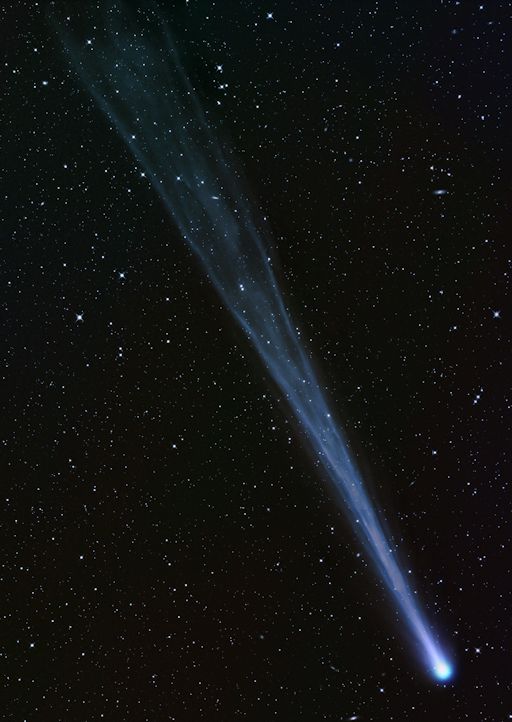
The tail is so long, he couldn't fit the whole thing in the field of view. How long is it? Comet ISON's tail extends more than 8 million kilometers behind the comet's nucleus. For comparison, that's 21 times the distance between Earth and the Moon.

Because so much gas and dust is spewing from the comet's core, it is impossible to see clearly what caused Comet ISON's outburst on Nov. 13-14. One possibility is that fresh veins of ice are opening up in the comet's nucleus, vaporizing furiously as ISON approaches the sun. Another possibility is that the nucleus has completely fragmented.

"If so, it will still be several days before we know for sure," says Karl Battams, an astronomer with NASA's Comet ISON Observing Campaign. "When comet nuclei fall apart, it’s not like a shrapnel-laden explosion. Instead, the chunks slowly drift apart at slightly different speeds. 

Given that ISON’s nucleus is shrouded in such a tremendous volume of light-scattering dust and gas right now, it will be almost impossible to determine this for at least a few days and perhaps not until the comet reaches the field of view of NASA's STEREO HI-1A instrument on November 21, 2013. We will have to wait for the chunks to drift apart a sufficient distance, assuming they don't crumble first." SpaceWeather

Friday, October 4, 2013

NASA's website shut down completely

Just one of NASA's breathtaking images of our Sun

NASA has completely shut down its website, no longer possible for users to obtain important information. Same thing has happened on NASA's Twitter accounts.

"Due to government shutdown, we will not be posting or responding from this account," the crew responsible for the Voyager 2 space probe wrote late Monday on Twitter. "Farewell, humans. Sort it out yourselves."

Last tweet from @NASAVoyager2 before its account suspension was “Sorry, but we won't be tweeting/responding to replies during the government shutdown. Be back as soon as possible!”

Other agencies and missions within NASA like @MarsCuriosity, @AsteroidWatch, @CassiniSaturn, @MarsRovers,  @NASAKennedy, @NASAAmes, etc.  have similar tweets.

CNN reports that NASA is just one of many federal government agencies affected when the U.S. government shut down at midnight Tuesday because of Congress' inability to pass a budget. 97% of its wok force of about 18,000 employees were furloughed on Tuesday.
 
One of NASA's images of a huge Earth-bound solar flare

So who will monitor the skies? There are observatories, academic institutions and other astronomers that are forming to watch the skies.

NASA will continue to support its two astronauts aboard the International Space Station, as well as spacecraft currently in space, Space.com reported.  "To protect the life of the crew as well as the assets themselves, we would continue to support planned operations of the ISS during any funding hiatus," the plan states, according to Space.com.  

It does sound like a nightmare that could shake science and global economy so it is therefore hoped that this situation would be a shortlived one, especially when many are now endlessly watching the night skies for certain apocalyptic signs...
In the meantime, amateur astronomers, academic groups and observatories worldwide will be watching the skies for signs of Comet ISON. This photograph taken by Canadian amateur astronomer Malcolm Park on Sept.29, 2013, does not show comet ISON itself but illustrates exactly where in the sky it can be seen by backyard astronomers with only moderate-sized telescopes. [Image credit: Malcolm Park, NYAA]