Showing posts with label BATTLE OF PAYE. Show all posts

Thursday, July 30, 2020

Labanan sa Paye: Balik-Tanaw sa mga unang buwan ng pananakop ng mga Amerikano sa isla ng Marinduque


Hulyo 31, 2020, ika-120 taong anibersaryo ng makasaysayang Labanan sa Paye


Lumang larawan ng bahagi ng simbahan ng Boac noong inokupa ito ng mga Amerikano para gawin nilang kampo pagkadaong nila sa Laylay. Wala pang labanan na nagaganap. Makikita ang flagpole habang nakawagayway ang kanilang bandila

Mga tala bago maganap noong July 31, 1900, ang engkwentro sa Sitio Paye, Balimbing, Boac na ginugunita ng mga Marinduqueno bilang ‘Labanan sa Paye’. 

Ito  ngayon ay isang special, non-working holiday sa buong lalawigan naaayon sa RA 9749; inaprubahan noong 2008, na nagdeklara sa Hulyo 31 ng bawat taon bilang Araw ng Labanan sa Paye sa lalawigan.

Bukas, ito ay ipagdiriwang sa bayan ng Boac sa panahon ng pandemya sa pamumuno ni Boac Mayor Armi DC Carrion. May pag-aalay ng bulaklak sa makasaysayang lugar sa Paye kung saan may dambanang nakatayo, subalit ang programa ay sa Boac Covered Court isasagawa sa ilalim ng "new normal" dulot ng pandemya.

Panauhing pandangal si Noel Rene Nieva mula sa lahi ng mga bayani ng Paye na sina Police Delegate Calixto Nieva at 2nd Lt. Gregorio Nieva. Magbibigay din ng kanilang mensahe sina Gov. Presbitero J Velasco, Jr., Cong. Lord Allan Velasco at Mayor Carrion.

Dambana ng Labanan sa Paye

Balik-Tanaw

Abril 25, 1900 dumaong sa may Laylay ang dalawang US navy gunboats. Kasama dito ni Col. Edward E. Hardin ang isang batalyon ng 29th US Voluteer (USV) Infantry. Deretso silang nagmartsa sa direksiyon ng Boac at inokupa ang simbahan ng Boac, walang kumontra, walang insidente.

Dahil inakala nilang tahimik sa isla, iniwan ang isang company (A/29) sa Boac at lumisan ang isang company patungo sa iba pang isla para kanilang maokupa.

Larawan ng pagdating sa Laylay ng mga sundalong Amerikano noong 25 Abril 1900

Walumput-walong sundalo lamang ang natira, kayat pitumput-dalawang tauhan ng Company D, 38th USV sa pamumuno ni Major Charles H. Muir ang ipinadala rito para reinforcement. Inikot ang isla pero wala silang namataan na mga guerilla at ang mga sibilyan ay namundok na rin.

Unang engkwentro

Mayo 19 isinama nina Muir at Capt. John Jordan ang limamput-pitong tauhan ng D/38 para manmanan ang kabundukan. Nakarating sila sa Santa Cruz at nakarating doon ng 7:00 Linggo ng umaga. Mga 1,000 tao ang kanilang nadatnan na nakikinig ng misa. Nagsipagtakbuhan pagkakita sa mga Amerikano, habang paakyat sa itaas ng bundok ang maraming guerilla.

Nagkaroon ng putukan at ginamitan ng mga Amerikano ng “bush tactics o Indian style” ng paglusob ang mga Pilipino. Ilang oras din ang inabot ng paggapang ng mga Amerikano sa bundok hanggang 300 yarda na lamang ang layo nila.

Tumirada na ng paglusob ang grupo ni Muir. Nagsipanakbuhan ang mga Pilipino sa ibat-ibang direksyon. Naiwan ay anim na patay na Pilipinong sundalo at isang bihag. 

Panalo ang mga Amerikano sa unang sagupaan sa Marinduque at wala silang casualty.

Sinundan ni Muir ang kanilang tagumpay sa pamamagitan ng paggalugad sa interior ng isla ng apat na araw. Nakabihag sila ng tatlumput-anim na mga gerilya ni Col. Maximo Abad na nakakalat sa ibat-ibang lugar. Dahil dito, napasuko ng mga Amerikano si Martin Lardizabal ang sibilyan na gobernador at si Abad na ang namuno.

Bilang tugon, ipinag-utos ni Muir na lumabas na sa simbahan ng Boac ang kanyang mga sundalo para magamit naman ng mga tao para sa mga misa ang simbahan.

Pagdating ng Hunyo, ipina-recall ni Bates sina Muir at Jordan at lahat nilang kasamahan (38th USV) sa Luzon at ipinalit sa kanila ang Company F, 29th USV sa pamumuno ni Capt. Devereux Shields.

Santa Cruz naman ang ginawang garrison ni Shields, at dahil tag-ulan tila walang umasa na may magaganap na di inaasahan. Ni wala silang balita tungkol kay Abad.

Kuha sa Sta. Cruz Church nang ginawa rin itong garison ng mga Amerikano, 1900. Larawan mula sa koleksiyon ni Curtis Shepard.

Si First Lieutenant William S. Wells naman, ang commander sa Boac, ay tila kampante na sa bayan dahil para sa kanya ay tahimik dito. Walang na-appont na over-all commander para sa buong isla.

Ang peligrosong sitwasyon ng mga Amerikano ay lumitaw noong July 31, 1900 ng inambush ng mga gerilya ni Kapitan Teofilo Roque ang isang bihirang pagmamanman sa kabukiran ng grupo ni Lt. Wells. Isang account mula sa The US Army's Pacification of Marinduque, Philippine Islands ni Andrew J. Birtle na pinagmulan ng panulat na ito, ay ganito ang nakasaad:

"The precariousness of the American position became evident on 31 July, when Teofilo Roque's Guerrilla ambushed one of Lieutenant Wells' rare forays into the countryside. Roque's force wounded two Americans and captured two others before the patrol escaped.
"That night the victorious guerrillas set fire to a portion of Boac in an effort to drive the Americans out. In this they failed, though many of Boac's inhabitants fled, leaving the town virtually deserted.
"The episode also succeeded in paralyzing Company A, which retired to the church, venturing out only twice over the next two months..."
Subalit ng maganap ang paglusob sa Paye ng ating mga sundalo ay wala nang urungan, wala nang atrasan. At nasundan pa ito pagkaraan ng isa at kalahating buwan ng isang labanan sa bahagi ng Torrijos-Sta. Cruz na gumulantang sa buong puwersang militar ng mga Amerikano nang makarating ang balita sa Amerika. Naging laman ng kanilang mga pahayagan ang para sa kanila ay mapangahas na pagkilos ng mga Marinduqueno.

Tampok sa mga pahayagan sa Estados Unidos ang naganap sa isla ng Marinduque.  Mula sa pananaliksik ni Curtis Shepard (Ulongbeach.com)

Doon nila unang narinig ang tungkol sa isla ng Marinduque at ang matinding pagtanggi at paglaban ng mga taga rito sa pananakop ng mga dayuhan kapalit ng kanilang buhay.

Tuesday, September 4, 2018

Flag of Marinduque Revolutionary Forces under the command of Col. Maximo Abad

Talking about Philippine revolutionary flags such as that of Andres Bonifacio, did you know that our Battle of Pulang Lupa Hero, Col. Maximo Abad led the Marinduque Revolutionary Forces with his own flag?


Col. Maximo Abad (left) with
Capt. Teofilo Roque beside him.
The present whereabouts of the Abad flag is still being investigated, unlike the 'personal flag' of Andres Bonifacio that is currently up for auction. The planned auction is however being stopped as a local legislator has stressed that under Section 7 of RA No. 10086 creating the National Historical Commission of the Philippines (NHCP), "to acquire important historical documents, collections, memorabilia and other objects that have significant value" is a mandate of the said Commission.


“Heritage memorabilia and other historical articles must be acquired by the National Historical Commission of the Philippines (NHCP) on behalf of the government for posterity rather than allowing them to be auctioned to private collectors, with the possibility that these historical articles will go to foreigners or foreign places beyond the access and appreciation of generations of Filipinos,” the legislator, Rep. Edcel Lagman said.

Flag of the Marinduque Revolutionary Forces under the command of Col. Maximo Abad.


Abad’s flag was the flag of the Marinduque Revolutionary Forces under his command. It was captured by the American forces in Marinduque in 1901 and is described as “a field flag measuring 18x30 inches. Its colors are red, white and blue with but two bars and a triangle white. In the triangle are handpainted characters representing the sun, surrounded by three large stars, which are black. The material of the flag is ordinary bunting”.

The above drawing is one version only of the flag posted by watawat.net based on a written description. 

Information about the flag came to the knowledge of local historical researcher, Curtis Shepard, and was shared with this blogger a couple of years ago. Shepard maintains a blog, ulongbeach.com devoted to publication of research materials on Marinduque's past. His investigations continue.

Wednesday, August 1, 2018

Labanan sa Paye, Kapitan Teofilo N. Roque, iba pang labanan sa Marinduque laban sa Kano

Kapitan Teofilo Navaroso Roque

Ipinagdiwang kahapon dito sa Marinduque ang makasaysayang Labanan sa Paye (July 31, 1900), na isang mahalagang bahagi ng Philippine-American War sa Marinduque (1900-1902). Isa ito sa dalawang makasaysayang kabanata noong 1900 na hindi na makakalimutan sa lokal na kasaysayan. 

Ang Digmaan sa Marinduque

Si Martin Lardizabal, military governor ng Marinduque ang nag-organisa ng Hukbong Rebolusyonaryo ng Marinduque ayon sa pag-uutos ni Mariano Trias ng Southern Command. 

Nagsimula naman ang panibagong pakikibaka, sa panahong katatapos pa lamang ng Spanish-Philippine War, nang dumating noong Abril 25, 1900 ang dalawang US Navy ships. Dumaong malapit sa Puerto Laylay, lulan ang isang batalyon ng 29th USV Infantry sa ilalim ni Col. Edward Hardin.

US soldiers wading ashore at Laylay, Boac, April 25, 1900

Matapos ang pakikipag-usap sa ilang mga prominenteng residente ng Boac, dumeretso ang mga sundalong Amerikano sa mala-citadel na simbahan ng Boac at ito ang ginawa nilang kuta. Walang pagtanggi o labanan na naganap. 

Pagkatapos ng ilan pang pagmamanman na wala pa ring anumang insidente, nagpasya si Hardin na tahimik ang isla. Iniwan ang Company A at naglayag papunta sa iba pang masasakop na mga isla sa labas ng Marinduque.

Si Lardizabal naman ay nagkasakit at hindi na magampanan ang kanyang tungkulin. Hinirang niya si Lt. Col. Maximo Abad bilang kanyang kapalit na mamuno sa hukbong rebolusyonaryo. Mayo 6, 1900 nang ang Hukbo ay hinati sa apat na guerilla units.

Si Teofilo Roque ang namuno sa 2nd Guerilla para mangalaga sa teritoryong Boac-Mogpog (kung saan naganap ang Labanan sa Paye).

May mga prominenteng personalidad sa kilusan na may kaugnayan sa isat-isa. Halimbawa, biyenan ni Abad si Kapitan Fausto Roque ng 1st Guerilla, at pinsan naman ni Fausto si Teofilo. Dahil dito, naisulat ni Andrew Birtle, isang US historian, na ang revolutionary struggle daw sa Marinduque ay matatag na nakaugat sa middle at upper classes ng isla na may kakayahang gamitin ang kanilang kapangyarihan at pagkilala ng mga tao para ang kilusan ay suportahan ng mga mamamayan.


Lumang larawan sa may simbahan ng Sta. Cruz, Marinduque


Labanan sa Sta .Cruz


Noong ika-19 ng Mayo 1900, umabot sa 57 ang mga kawal Amerikano ng Company D/38 na nagmartsa papuntang Sta. Cruz, at nakarating doon ng 7:00 ng umaga, Linggo. Nadatnan nila ang may mga 1,000 katao na dumalo sa maagang misa.


Karamihan sa mga tao ay sakop ng paningin ng mga Amerikano bagamat pansin din nila na ang mga gerilya ay naka-deploy sa ibabaw ng isang burol.

Nagsagawa ng tinatawag na ‘bush tactic o Indian style’ na paglusob ang mga Amerikano. Sa pangunguna ni Major Charles H. Muir biglaang rumatrat at nasapol kaagad ang ilang mga Filipino mula sa kanilang pinagkukublihan. Nagtalsikan papunta sa ibat-ibang direksiyon.

Anim kaagad ang namatay na mga Filipinong sundalo at isa ang nabihag. Napagtagumpayan ng mga Kano ang unang labanan sa Marinduque na wala silang casualty.

Matapos ang pangyayari, nagpasya ang may karamdamang si Martin Lardizabal na sumuko na lamang. Nanatili para sa pakikipaglaban sina Abad at mga kasamahan sa kabundukan.

Battle of Paye Historical Landmark

Labanan sa Paye

Samantala, ang komandanteng Amerikano sa Boac, si First Lieutenant William S. Wells ng Company A, 29th USV naman ay tila naging kampante sa panahong iyon dahil tag-ulan. At dahil walang nagaganap na ano mang insidente o engkuwentro sa lugar. Nanatili na lamang sila sa loob ng simbahan.

Sa isang pambihirang pagkilos ni Wells, nagsagawa siya ng isang reconnaissance march sa kanayunan hanggang makarating sa Balimbing. Ito na ang naganap na pagsalakay sa kanila ng mga gerilya ni Teofilo Roque noong Hulyo 31, 1900.

Habang nasa tabing ilog ang mga sundalong Amerikano, sinalakay sila ng mga pwersa ni Roque, nasugatan ang dalawang Amerikano at binihag ang dalawa pa. Ang isa sa mga binihag ay nakilalang isang negosyanteng Ingles na matagal nang naninirahan sa Boac, kilala lamang bilang si ‘Macky’ o R.D. Macky.
Kuha ito sa Simbahan sa Sta. Cruz, Marinduque na ginawa ring kuta ng mga Kano.
Ganito rin ang naganap sa simbahan ng Boac na una nang ginawa nilang kuta.
Larawan mula sa mga Koleksyon ni Curtis Shepard.

Ang nagulantang na mga Amerikano ay umatras at tumakas sa kahabaan ng mga 7-milyang layo mula sa Paye hanggang nakabalik sila sa Simbahan ng Boac.

Ayon sa tala, nang gabing iyon, ang mga nagwaging mga gerilya ang nagsunog sa isang bahagi ng Boac na tinatawag na Mataas na Bayan, malapit sa simbahan sa pagsisikap na tuluyang palayasin ang mga Kano.

Nagsilikas ang mga naninirahan sa bayan at halos walang taong natira. Paralisado naman, di makagalaw, nanginig sa takot, 'cowering', ang Company A sa loob ng simbahan.  

Ang pagkatalo ng mga Amerikano sa Paye ay isang maliwanag na babala, sapagkat ito ay hahantong sa isa pang malaking pagkatalo ng puwersang banyaga, pagkaraan ng anim na linggo sa Labanan sa Masaguisi, mas kilala sa tawag na Labanan sa Pulang Lupa -  ang tinaring mismo ng mga US historians bilang “one of the worst reversals suffered by US forces...  sending shock waves through the American high command."


(May kasunod)

Monday, August 31, 2015

Remembering Col. Maximo Abad on National Heroes Day, Marinduque concentration camps, burning of houses

National Heroes Day in the Philippines (last Monday of August), is a national public holiday to honor and remember the country’s national heroes, both known and unknown whose acts of courage enabled the Philippines to grow as a nation.


Towering among local heroes in the island-province of Marinduque is Col. Maximo Abad, hero of the Philippine-American War, the second phase of the Philippine revolution. Abad led the Marinduque revolutionary forces and defeated the Americans in the "Battle of Pulang Lupa". 
Many historical buffs could easily draw the conclusion that the exploits of the more celebrated national heroes would pale in comparison to the war exploits in that battle of this great local hero.
The most comprehensive account of the U.S. Army's pacification of Marinduque was authored by Andrew J. Birtle and was published in the Journal of Military History 61 (April 1997).
Conclusively in that comprehensive article, Marinduque in those days was where the earliest harsh employment of "population concentration", euphemism for concentration camps, the burning of houses and other forms of violence against men and animals were used as technique to make people subservient to new foreign masters. Shades of this technique are uncannily still employed in this tiny island-province until today - to bring people into subservience as a study of its contemporary political history will show.
The Birtle account begins with the following gripping lines:
“The severity with which the inhabitants have been dealt would not look well if a complete history of it were written out”.  
”So wrote Philippine Commissioner William Howard Taft concerning the U.S. Army's campaign on the island of Marinduque during the Philippine War of 1899-1902. The pacification of Marinduque was characterized by extensive devastation and marked one of the earliest employments of population concentration in the Philippine War, techniques that would eventually be used on a much larger scale in the two most famous campaigns of the war, those of Brigadier Generals J. Franklin Bell in Batangas and Jacob H. Smith in Samar..." 
Taft would later become the Governor-General of the Philippines and later serve as the 27th President of the United States (1909-1913).
But other than the Birtle account, what more do we know about Col. Maximo Abad since very little is known about his life?
A couple of days ago, thanks to the Internet, I have received via this blog additional information from a reader, RA Sor, as comment to an article I wrote five years ago, "Tracing the footsteps of Col. Maximo Abad" which, in the spirit of National Heroes Day, are both reproduced below: 
AvatarRamon L. Abad is half brother of Ramon "Daddy Amon" Sunico, Francisca "Mama Ne" Sunico-Monzon (wife of MLQU founder Chairman and President Leoncio Monzon and Julito Sunico. Consolacion Lozano Abad was married to a Sunico, widowed then married Col. Abad.


    • Avatar


      Colonel Maximo Abad married a Consolacion Lozano (pure Spanish decent daughter of a Galleon Captain Lozano. Colonel Maximo Abad was father to Ramon L. Abad. However he had other issue from other women in his life.

      Col. Abad lived with his family in Pikit North Cotobato, he was an applicant for homesead patent in Pikit, however the Japanese War prevented titling in his name of the land he developed. His lot houses the Municipal Government, School, Church and of late a pineapple farm which operates on his property without the consent of his heirs.
      Documents relative to his ownership over said lot is in Malacanang Library, a case was filed in Pikit with counsel Atty. Benedicto on record.

    TRACING THE FOOTSTEPS OF COLONEL MAXIMO ABAD

    by Eli J. Obligacion

    (Photo: Labanan sa Pulang Lupa dance-drama, 2007, written and directed by Eli J. Obligacion)

    TRACING THE FOOTSTEPS OF COL. MAXIMO ABAD... AND CAPT. TEOFILO ROQUE


    Lt. Col. Maximo Abad is probably one of the most elusive among the Filipino soldiers who fought during the Philippine-American War, the hero who led the Marinduque revolutionary forces and defeated the Americans in the “Battle of Pulang Lupa”. During the last four decades after the first commemoration in Marinduque of this, now annually-celebrated event, facts about Abad have remained equally elusive. 

    So little is known about him – the Maximo Abad who tenaciously adhered to the cause of Marinduque’s defense and Philippine Independence. For one, the name does not appear in the Centennial Resource Book, “Ang mga Bayani sa Ating Kasaysayan” listing of famous and unsung heroes, a project completed in connection with the Philippine Centennial in 1998. 

    The Philippine National Police provincial headquarters in Marinduque is named after him: “Camp Col. Maximo Abad”. Yet, for years the Camp has tried, in vain, to also trace his mother's surname so the initial could be appended between “Maximo” and “Abad” in the welcome signage there.

    Since nothing really appears to have been written about Abad’s background, (except his well-documented exploits in the Marinduque battle), we felt it appropriate to try to dig into some old documents, surf, recollect, and ask around here to trace his steps, to know a bit more about our celebrated hero. After all, August 31 is a holiday for national heroes. 

    Birtle (U.S. Army’s Pacification Campaign in Marinduque, April 1900-April 1901), described him as “a moustachioed school teacher from Luzon’s Cavite province”. We dig up an old Boac fiesta souvenir program with a brief description of the town’s history naming Maximo Abad as a “Maestro” in the first school for boys established there, “Escuela de Nino”, and that he was from Imus. Imus, of course, has always been associated with the resistance movement, and this might explain his early association with Gen. Mariano Trias, from whom he’d eventually be getting orders in the course of his Marinduque exploits. So we’re beginning to find connections. 

    Birtle contends that the civil and military leadership of the resistance movement on Marinduque was firmly rooted in the island's middle and upper classes, and that the insurrection was also in many ways a 
    family affair. 

    The American writer then goes on to tell us that Abad’s brother-in-law, Capt. Fausto Roque commanded the 1st Guerilla, and that Fausto had a cousin, Teofilo Roque (of the Battle of Paye fame whose biography also appears nowhere and likewise, needs to be written for history buffs). Teofilo commanded the 2nd Guerilla. 

    That leads us to the Roque residence in Mercado St., Boac, hoping to find more clues, particularly the name of Abad’s wife and children, if any, because that was our original intent.

    We find that Fausto and Teofilo were cousins, indeed. But at the moment, no one remembers the name of Maximo’s beloved wife. They had a son for sure, we are told, but there's uncertainty if they had other children too.

    We, however, unearth some information about Teofilo, the Paye hero. Teofilo was born in 1873, the son of Tomas Roque*, native of Bulacan, and Juana Navaroso, a local lass from Boac. Teofilo was the third of nine children. He graduated as a law student at Ateneo de Manila, and was still a bachelor in 1898, when he served as Lieutenant in the Marinduque Revolutionary Force.

    By the time the Paye episode transpired he was already married to Filomena “Nena” Morente. The marriage did not produce any offspring. He was 60 when his wife died, then moved to Manila where he died in August 1942 at age 69. That appeared to give us some idea about the Teofilo Roque persona.

    Then we zoom in again on the Abad character, one who has been described as passive, and turn to the internet. 

    Wikipedia credits Abad for being one of Gen. Licerio Geronimo's riflemen in the Battle of San Mateo (erroneously referred in that site and in many other sites as "Battle of Paye"), which occured on Dec. 19, 1899. But since a major confusion has been caused by Wikipedia in calling it by another name, and considering the fact that it was Abad's men who were involved in the real Battle of Paye on July 31, 1900, in Boac, Marinduque (led by Capt. Teofilo Roque), we'll have to consider it a confused claim unless backed up by verifiable references.

    We then discover the text of a Supreme Court document dated Oct. 22, 1902, that showed Abad was earlier charged and convicted for having denied to an officer of the U.S. Army the existence of certain rifles which had been concealed at the time of his surrender in April 1901. It appears that he appealed the conviction and the Supreme Court held that the violation committed by the appellant Abad falls within the scope of “treason” and “sedition” and covered by the amnesty proclamation. The Court decided that Abad was entitled to the benefits of the proclamation and ordered that he be discharged
    .
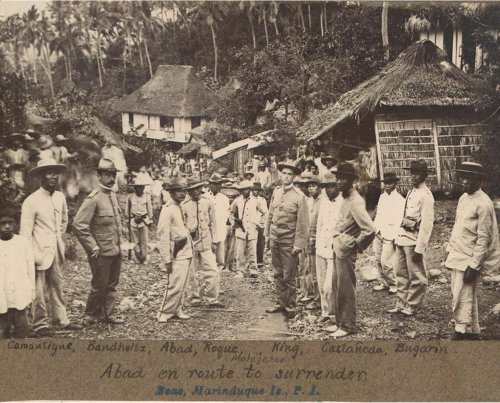
    The Maximo Abad surrender photo. Abad is accompanied in this photo by his comrades who had earlier surrendered, and by Col. Harry Hill Bandholtz of the Philippine Constabulary.

    So, this shows that the Americans pulled one over him after having dangled the carrot that ensured fair treatment if he surrendered. He did surrender on April 15, 1901, at Boac’s town plaza in an impressive ceremony attended by the townspeople.

    We then come across other leads, chancing upon a listing of municipal heads in Imus from 1888 to the present which showed an entry: “Maximo Abad (1910-1912)”. That appears to tell us that our man returned to Imus and even became its mayor eight years later.

    What happens next? A passage from Cotabato’s history states a new twist, thus:

    “The first Christian settlers in Cotabato from outside of Mindanao, mostly coming from the province of Cebu, arrived in Pikit on June 17, 1913 at the behest and as a result of the efforts of the late President Sergio Osmeña, who was then the Speaker of the Philippine Commission. Expenses of their transfer to the "Land of Promise" were subsidized by the government. The administrator of the colonies given to the settlers at that time was a superintendent by the name of Maximo Abad, a government appointed official, who took care of the settlers’ needs like food and farm implements. There were six more batches of colonies that arrived thereafter...”

    It therefore appears that the adventurous spirit of Abad never waned and he journeyed to a vaster frontier that imposed bigger challenges.

    Col. Maximo Abad

    Finally, we find something as we come across a site attempting to trace genealogies:

    “Col. Maximo Abad (deceased) Husband of unknown and Consolacion; Father of Ramon Lozano Abad and Josefina”

    And related information stating that “Ramon Lozano Abad” was “Half-brother of Ramon, Francisco and Julito”

    Fresh leads. He appears to have remarried and raised more children, and three appear to be half-brothers. In time, someone might prove instrumental when we finally gain access to the Revolutionary Papers tightly guarded within the confines of the National Archives.

    It's not an easy task to put it all together. But we're seized by the inescapable feeling that tracing the paths of an elusive person brings. We feel it's a good start. A great National Heroes Day for me, I might say.


    Sources:
    (*Tomas Roque (Dec. 29, 1841-June 6, 1907): Boac Gobernadorcillo from 1877-1979 and 1897-1898. Helped in the local distribution of Rizal’s “Noli Me Tangere” and “El Filibustrismo” together with Marcelo Mirafuente of Boac; was authorized by Gen. Emilio Aguinaldo in 1898 to recruit and train soldiers who eventually figured in the Paye and Pulang Lupa battles. “Tomas Roque Street” in Boac named after him.
    Source: Document from granddaughter Juanita Roque-Enriquez as told by Joaquin Roque, a son of Tomas Roque)

    The Journal of Military History 61(April 1997) The U.S. Army's Pacification of Marinduque, Philippine Islands, April 1900-April 1901 by Andrew J. Birtle.
    Interview with Mrs. Fe Corazon Enriquez-Recalde. She supplied documents on Teofilo Roque prepared by her mother, Juanita Roque based on an account by Joaquin Roque, a brother of Teofilo.

    http://www.wowphilippines.com.ph/explore_phil/place_details.asp?content=history&province=61
    http://www.msc.edu.ph/centennial/hero/bicol/page10.html
    www.en.wikipedia.org
    www.ulongbeach.com
    www.gini.com

    Libingan ng mga Bayani in Fort Bonifacio figures in today's commemoration.
    Now where's Col. Maximo Abad's resting place?

    Friday, August 3, 2012

    Marinduque Cong. Lord Allan Velasco: 'Breathing new life and hope'


    Congressman Lord Allan Velasco

    Cong. Velasco spoke during the 112th anniversary of the Battle of Paye in Boac, celebrated as a special non-working holiday in Marinduque, an episode during the Filipino-American War marked as historically significant.


    "It's true what they had been saying about the youthful Congressman Lord Allan Velasco of Marinduque whom I had never met. He had certainly done a lot for the province that he represents. He had discovered new places of interest and is now in the process of developing them, including underground rivers, the island of Maniwaya and enchanted caves. Most of all, he inspires the people of Marinduque, breathing new life and hope into them, most of whom are now dreaming their own big dreams for their hometown. Truly, Marinduque, the heart of the Philippines is breathing, pulsating with life!" - Dolly Dy Zulueta, The Marinduque Diaries, flavorsoflife.com


    Velasco's message at the 112th anniversary of the Battle of Paye three days ago: As your representative who continues to dialogue with you, I am of the firm belief that the doors of opportunity we've been waiting for have widely opened now. We have achieved so much in the areas of infrastructure, livelihood, health, education, agriculture, sitio electrification, tourism and, most of all, in the high level of awareness on the real strength of the Marinduqueno.


    During the speech, Velasco also thanked the officials of government, the soldiers, workers in the various industries, professionals, and students, whom he said "have not ceased to pose critical questions, make their own voices be heard, pushing forward fresh ideas." The same goes, he said, for those in the barangays who have kept their minds open for that fulfillment of change."


    "Ang tutok natin ngayon ay nasa pag-unlad. Masasabi ko po na ang mga hamon sa atin sa kasalukuyan ay hindi kasing hirap ng dinanas ng mga henerasyong nauna sa atin. Subalit ang puwersa ng pagiging matuwid o makatuwiran, ang katatagan at katalihuhan, na gamit ng mga nauna sa atin ay ganun pa rin ang kahalagahan at kabuluhan sa kasalukuyan" - Cong. Velasco
    As chief executive of the Municipality of Boac, Mayor Roberto Madla spearheaded the provincial event in cooperation with the National Historical Commission of the Philippines and the Provincial Government of Marinduque.

    From left: Dr. Leodegario M. Jalos, Jr,. MSC vice-president for academic affairs  and descendant of a Paye hero, Lt. Antonio Jalos, as guest of honor; Congressman Velasco, Vice-Governor Antonio Uy and Boac Mayor Roberto M. Madla.

    Medical and dental mission, Poblacion (Torrijos), Bocboc and Puting Buhangin (Mogpog).

    Prior to the July 31st Battle of Paye observance, Velasco personally attended the conduct of  medical and dental missions for indigents in Torrijos and barangays Bocboc and Puting Buhangin in Mogpog. Upon his initiative, corporations like Petron and San Miguel Corporation sponsored the two-day mission that saw hundreds of patients treated for various ailments and for tooth extraction. The mission, he said, obtained the full support of no less than SMC president, Ramon S. Ang.
    The elderly.

    Infants' mothers, kids and people of all ages were one in expressing their thanks to the hardworking team of medical doctors, dentists, nurses and volunteers who were there to respond to their needs, including free medicines. Video on the medical mission held on July 29-30 follows: