Showing posts with label MAXIMO ABAD. Show all posts

Friday, September 11, 2020

Miguel "Myke" Magalang and his work "Col. Maximo Abad: Exultations and Twinges in his Life Stories"


The province of Marinduque commemorates the 120th Anniversary of the Battle of Pulang Lupa on September 13 in Torrijos, Marinduque. 

The late historian and environmental champion, Miguel 'Myke" Magalang employed patience and hard work to gather information from primary and secondary sources and other significant government documents in the writing of his work, COL. MAXIMO ABAD, EXULTATIONS AND TWINGES IN HIS LIFE STORIES


MAGALANG'S INTRODUCTION:

The eminence and prominence that Col. Maximo Abad played in the war for independence by the people of Marinduque during the Filipino-Spanish War and the Filipino-American War, and his post-war achievements, feats and exploits that significantly changed the course of history and story of this Island Province. Eli Obligacion in his blog endeavoured in “Tracing the Footsteps of Col. Maximo Abad” (Obligacion: 2009) where he mentioned that:  

“Lt. Col. Maximo Abad is probably one of the most elusive among the Filipino soldiers who fought during the Philippine-American War, the hero who led the Marinduque revolutionary forces and defeated the Americans in the “Battle of Pulang Lupa”. During the last four decades after the first commemoration in Marinduque of this, now annually-celebrated event, facts about Abad have remained equally elusive.  

“So little is known about him – the Maximo Abad who tenaciously adhered to the cause of Marinduque’s defense and Philippine Independence.”

As student of history, the author was challenged to also add up to the needed information on Maximo Abad and to fill in the gaps, little by little, on his life story. With the initial information gathered by Obligacion, patience and hard work were employed to look for and gather important information from primary sources of local history and other significant government documents, secondary sources and other references in order to validate the information in his initial research. 

This paper is a work in progress for the last few years. References were compiled since the year 1998 (Philippine Independence Centennial) to give light to the various periods in the life stories of Col. Maximo Abad and other events in the island of Marinduque and the Pueblo of Boac. This aims to provide references to students and teachers of local history so that the future generations will have a fair and better understanding of the lives and contributions of our local heroes, and the events that shaped the historical and cultural development of this Island.


INITIAL YEARS OF MAESTRO ABAD IN MARINDUQUE: THE SPANISH ERA

The author has found a short biography of Maximo Abad in the “Galeria de Filipino Ilustres” (Artigas y Cuerva: 1917) which is available in the University of Michigan Digital Collection. Pages 18 and 19 of the “Galeria” are provided below for reference purposes.

This is a valuable find which gives enough information on Maximo and validates some events in the life of Maximo posited by Obligacion.


Magalang's work can be accessed in CURTIS SHEPARD'S website in this link 


REPUBLIC ACT NO. 6702
AN ACT DECLARING SEPTEMBER THIRTEEN AS BATTLE OF PULANG LUPA DAY AND A SPECIAL NON-WORKING HOLIDAY IN THE PROVINCE OF MARINDUQUE

Section 1. Every September thirty is hereby declared as Battle of Pulang Lupa Day and a special non-working holiday in the Province of Marinduque to commemorate the battle of Pulang Lupa.

Sec. 2. This Act shall take effect upon its approval.

Enacted without executive approval, February 10, 1989.

Image may contain: text that says 'PHILIPPINES MARINDUQUE JALPOIAS PUPNG ENTENARYO PILIPINAS OWNIVERSARY 2020 1900 20 120 th Anniversary Celebration Battle of PULANG LUPA THEME: "Ikaw, Ako, Tayo ay Bayani... Ang COVID-19 ating Magagapi!" September 13, 2020 8:00 AM Pulang Lupa Battle Site Barangay Bolo, Torrijos, Marinduque Guest of Honor and Speaker PGEN CAMILO PANCRATIUS P CASCOLAN Chief, Philippine National Police Republic Act No. 6702 An Act Declaring September Thirteen as Battle of Pulang upa Day and Special Non-Working Holiday in the Province Marinduque'
PGen Camilo Pancratius P Cascolan is guest of honor 
and speaker in this year's anniversary celebration

Thursday, August 1, 2019

Isa pang Balik-Tanaw sa mga Labanan sa Sta. Cruz at Paye

Si Lt. Col. Maximo Abad ang nasa kaliwa,
si Kapitan Teofilo Roque ang nasa kanan.


History Month ang buwan ng Agosto kaya makibahagi tayo sa isang bahagi ng lokal na kasaysayang may kinalaman sa Labanan sa Sta. Cruz at Labanan sa Paye

Bago maganap noong July 31, 1900, ang engkwentro sa Sitio Paye, Balimbing, Boac na ginugunita ng mga Marinduqueno bilang ‘Labanan sa Paye’, isang special, non-working holiday sa buong lalawigan, magandang malaman ang ilang naganap bago pa ang sa Paye.

Kahapon nga lamang July 31 ay ginunita ito doon.


Abril 25, 1900 dumaong sa may Laylay ang dalawang US navy gunboats. Kasama dito ni Col. Edward E. Hardin ang isang battalion ng 29th US Voluteer (USV) Infantry. Deretso silang nagmartsa sa direksiyon ng Boac at inokupa ang simbahan ng Boac, walang kumontra, walang insidente.

Dahil inakala nilang tahimik sa isla, iniwan ang isang company (A/29) sa Boac at lumisan ang isang company patungo sa iba pang isla para kanilang maokupa.

Pagdating sa Laylay ng mga sundalong Amerikano noong 25 Abril 1900

Walumput-walong sundalo lamang ang natira, kayat pitumput-dalawang tauhan ng Company D, 38th USV sa pamumuno ni Major Charles H. Muir ang ipinadala rito para reinforcement. Inikot ang isla pero wala silang namataan na mga guerilla at ang mga sibilyan ay namundok na rin.

Unang engkwentro

Mayo 19 isinama nina Muir at Capt. John Jordan ang limamput-pitong tauhan ng D/38 para manmanan ang kabundukan. Nakarating sila sa Santa Cruz at nakarating doon ng 7:00 Linggo ng umaga. Mga 1,000 tao ang kanilang nadatnan na nakikinig ng misa. Nagsipagtakbuhan pagkakita sa mga Amerikano, habang paakyat sa itaas ng bundok ang maraming guerilla.

Nagkaroon ng putukan at ginamitan ng mga Amerikano ng “bush tactics o Indian style” ng paglusob ang mga Pilipino. Ilang oras din ang inabot ng paggapang ng mga Amerikano sa bundok hanggang 300 yarda na lamang ang layo nila.

Tumirada na ng paglusob ang grupo ni Muir. Nagsipanakbuhan ang mga Pilipino sa ibat-ibang direksyon. Naiwan ay anim na patay na Pilipinong sundalo at isang bihag. 

Panalo ang mga Amerikano sa unang sagupaan sa Marinduque at wala silang casualty.

Sinundan ni Muir ang kanilang tagumpay sa paggalugad sa interior ng isla ng apat na araw. Nakabihag sila ng tatlumput-anim na mga gerilya ni Col. Maximo Abad na nakakalat sa ibat-ibang lugar. Dahil dito, sumuko sa mga Amerikano si Martin Lardizabal ang sibilyan na gobernador.

Bilang tugon, ipinag-utos ni Muir na lumabas na sa simbahan ng Boac ang kanyang mga sundalo para magamit naman ng mga tao para sa mga misa ang simbahan.

Pagdating ng Hunyo, ipina-recall ni Bates sina Muir at Jordan at lahat nilang kasamahan (38th USV) sa Luzon at ipinalit sa kanila ang Company F, 29th USV sa pamumuno ni Capt. Devereux Shields.

Santa Cruz naman ang ginawang garrison ni Shields, at dahil tag-ulan tila walang umasa na may magaganap na di inaasahan. Ni walang balita tungkol kay Abad.

Kuha sa Sta. Cruz Church nang ginawa itong garison ng mga Amerikano, 1900

Si First Lieutenant William S. Wells naman, ang commander sa Boac, ay tila kampante na sa bayan dahil para sa kanya ay tahimik dito. Walang na-appont na over-all commander para sa buong isla.

Ang peligrosong sitwasyon ng mga Amerikano ay lumitaw noong July 31, 1900 ng inambush ng mga gerilya ni Kapitan Teofilo Roque ang isang bihirang pagmamanman sa kabukiran ng grupo ni Lt. Wells. Isang account mula sa The US Army's Pacification of Marinduque, Philippine Islands ni Andrew J. Birtle ay ganito ang nakasaad:

The precariousness of the American position became evident on 31 July, when Teofilo Roque's Guerrilla ambushed one of Lieutenant Wells' rare forays into the countryside. Roque's force wounded two Americans and captured two others before the patrol escaped.
That night the victorious guerrillas set fire to a portion of Boac in an effort to drive the Americans out. In this they failed, though many of Boac's inhabitants fled, leaving the town virtually deserted.
The episode also succeeded in paralyzing Company A, which retired to the church, venturing out only twice over the next two months.

At alam na nating lahat na mga Marinduqueno: ang matagumpay na Labanan sa Paye ay nasundan pa ng isang labanan sa Torrijos-Sta. Cruz na mas kilala bilang Labanan sa Pulang Lupa.

Thursday, November 1, 2018

Marinduque heroes remembered but forgotten once more in modern day historical amnesia?

What remains of the Cemeterio de Tampus gate

According to oral history, Cemeterio de Tampus was the final resting place of Martin Lardizabal, Marinduque’s first military governor during the first phase of the Philippine revolution in this island-province. 

When the Philippine-American War started Lardizabal was still the governor but due to a lingering illness he appointed Col. Maximo Abad, Chief of the Marinduque Revolutionary Force to replace him.

If the local Church’s death records of that period are still intact today, Lardizabal’s burial place has remained undocumented, however. Surviving descendants may still have memories of one of Marinduque’s noble heroes.

The Church of Boac

Ten years ago in 2008, however, the Philippine Senate in a move to honor the courage and self-sacrifice of Filipino heroes whose deeds remain lost in history books and in memories of the people, adopted a Resolution. 

Resolution No. 54 was adopted for the establishment of a separate grave site or a memorial in Libingan ng mga Bayani to honor the heroism of all Filipino soldiers during the Philippine-American War.

In this significant Resolution lesser known names were cited and included the names of Marinduque’s Martin Lardizabal and Ciriaco Vida (known in those days as “Alapaap”).
Curiously, the name of Marinduque’s foremost hero, Col. Maximo Abad, of the ‘Battle of Pulang Lupa’ in 1900 was not included. Ciriano Vida was one of Abad’s trusted officers.

Image result for libingan ng mga bayani dnd memorial for Philippine-American War heroes

Libingan ng mga Bayani

This was established by the Philippine Government in 1947, then known as the Republic Memorial Cemetery, to commemorate the lives of fallen Filipino soldiers who fought in World War II.

Established in 1947, Libingan ng mga Bayani was first known as the Republic Memorial Cemetery. It was established by the Philippine government to commemorate the lives of the fallen Filipino soldiers who fought in World War II. 

Based on the Allocation of Cemetery Plots at the Libingan, veterans of the Philippine Revolution of 1890, World War I, World War II and recognized guerillas could be interred there alongside Filipino military personnel, other heroes and patriots.

A Memorial for the Philippine-American War heroes should suffice if remains could not be interred. But has such a memorial for the heroes of what was once called by the Americans as “Philippine Insurrection” been built in our time? Ten years after the Senate’s Resolution?


Image result for battle of pulang lupa
Teatro Balangaw Ensemble in a Battle of Pulang Lupa commemoration (2007)


Republic of the Philippines
Congress of the Philippines
SENATE
Pasay City
14th Congress
First Regular Session

Resolution No. 54

RESOLUTION URGING THE DEPARTMENT OF NATIONAL DEFENSE TO ESTABLISH A SEPARATE GRAVE SITE OR A MEMORIAL IN THE LIBINGAN NG MGA BAYANI TO HONOR THE HEROISM OF ALL THE FILIPINO SOLDIERS WHO COURAGEOUSLY FOUGHT IN THE PHILIPPINE-AMERICAN WAR

WHEREAS, ON February 4, 1899, or one hundred and six (106) years ago, American Sentry Private William W. Grayson haplessly fired at two Filipinos (one of whom was identified as Anastacio Felix), who were innocently passing along Calle Sosiego;

WHEREAS, that day marks the beginning of the Philippine-American War, a fourteen-year bloody struggle between the Filipinos and Americans;

WHEREAS, FOR ALMOST A CENTURY, THE Philippine-American War has been dismissed by the Westerners as the “Philippine Insurrection”, in an effort to paint a false picture of a second-class people, barely unable to stand up against their white colonizers;

WHEREAS, IT WAS ONLY IN 1979 THAT THE INACCURATE TERM :Philippine Insurrection” was officially designated as the “Philippine-American War” by the United States Library of Congress;

"WHEREAS, during the Philippine-American War, Filipino soldiers, though limited in rifles and ammunition and armed mostly with bolos and bamboo spears, bravely risked their lives to achieve independence;

WHEREAS, General Emilio Aguinaldo, Macario Salcay and General Mariano Lukban are among the familiar names, which come to mind as Filipino heroes during the Pliilippine-American War;

WHEREAS, less popular characters such as Juan Cailles, Martin Lardizabal and Ciriaco Vida, as well as almost 16,000 names of Filipino soldiers who selflessly laid down their lives during the Philippine-American War remain lost in Philippine history books and, sadly, in the memories of the Filipino people;

WHEREAS, the heroism and patriotism of the Filipino men and women, who refused to succumb to American rule, but fought for freedom to the point of death, should not be lost in historical amnesia;

WHEREAS, the heroes and heroines of the Philippine-American War, especially those not identified in the scrolls of history, should be honored for their courage and self-sacrifice, and remembered as a testament of the Filipino people’s love for their country, especially in these times of national crisis;

WHEREAS, it is important that the heroic deeds and patriotism of the Filipino heroes and heroines during the Philippine-American War be honored and immortalized in the hearts and minds of the Filipino people, especially the youth, who can draw inspiration from the ideals and the patriotism, and even learn from the mistakes, of the Filipino men and women who fought for Philippine independence;

WHEREAS, the Libingan ng mga Bayani is a public memorial cemetery for the gallant Filipino men and women who brought honor to the country and who fought for the sake of freedom;

WHEREAS, the Libingan ng mga Bayani does not have a separate grave site designated, nor a memorial structure established in honor of the valiant Filipino soldiers who fought in the Philippine-American War;

WHEREAS, pursuant to Presidential Decree No. 107 issued on January 26, 1977, the Department of National Defense is the agency tasked with the “administration, maintenance and development” of the Libingan ng mga Bayani: Now, therefore be it

Resolved, further. That the Senate of the Philippines calls on the Department of Education and the National Historical Institute to conduct, using the Filipino’s own perspective, studies and research on the personalities involved and the events which transpired during the Philippine-War, and to popularize and inculcate among Filipinos, especially the students, the heroism of the Filipinos during such important period of Philippine history.

Adopted,

MANNY VILLAR
President of the Senate

This Resolution was adopted by the Senate on February 4, 2008.


Tuesday, September 4, 2018

Flag of Marinduque Revolutionary Forces under the command of Col. Maximo Abad

Talking about Philippine revolutionary flags such as that of Andres Bonifacio, did you know that our Battle of Pulang Lupa Hero, Col. Maximo Abad led the Marinduque Revolutionary Forces with his own flag?


Col. Maximo Abad (left) with
Capt. Teofilo Roque beside him.
The present whereabouts of the Abad flag is still being investigated, unlike the 'personal flag' of Andres Bonifacio that is currently up for auction. The planned auction is however being stopped as a local legislator has stressed that under Section 7 of RA No. 10086 creating the National Historical Commission of the Philippines (NHCP), "to acquire important historical documents, collections, memorabilia and other objects that have significant value" is a mandate of the said Commission.


“Heritage memorabilia and other historical articles must be acquired by the National Historical Commission of the Philippines (NHCP) on behalf of the government for posterity rather than allowing them to be auctioned to private collectors, with the possibility that these historical articles will go to foreigners or foreign places beyond the access and appreciation of generations of Filipinos,” the legislator, Rep. Edcel Lagman said.

Flag of the Marinduque Revolutionary Forces under the command of Col. Maximo Abad.


Abad’s flag was the flag of the Marinduque Revolutionary Forces under his command. It was captured by the American forces in Marinduque in 1901 and is described as “a field flag measuring 18x30 inches. Its colors are red, white and blue with but two bars and a triangle white. In the triangle are handpainted characters representing the sun, surrounded by three large stars, which are black. The material of the flag is ordinary bunting”.

The above drawing is one version only of the flag posted by watawat.net based on a written description. 

Information about the flag came to the knowledge of local historical researcher, Curtis Shepard, and was shared with this blogger a couple of years ago. Shepard maintains a blog, ulongbeach.com devoted to publication of research materials on Marinduque's past. His investigations continue.

Tuesday, September 13, 2016

Battle of Pulang Lupa/Battle of Masaguisi


Battle of Pulang Lupa commemorative stamp issued by the Philippine Postal Corporation in 2000.


 “The marker stands at the site of the famous battle won by the Marinduquenos over the well-armed American forces on Sept. 13, 1900. The Americans led by Capt. Deverieux Shields surrendered to the Marinduque Revolutionary Forces led by Col. Maximo Abad. They were held captive for a month and were released on October 14, 1900 upon orders from the Revolutionary Government in Cavite.” – says the Battle of Pulang Lupa Historical Park Signage in Poctoy, Torrijos, Marinduque, courtesy of the Department of Tourism, LGU Torrijos and Philippine Tourism Authority.

This battle has been commemorated from the early 60s when September 13 was first declared as ”Marinduque Day” under the administration of Pres. Diosdado Macapagal, then by President Ferdinand E. Marcos who issued a proclamation referring to it also as “Marinduque Day”. It was only during the term of President Corazon C. Aquino when a law was passed (RA 6702) in 1988 declaring September 13 of every year as “Battle of Pulang Lupa Day”.


Teatro Balangaw group re-enacting the battle.
This blogger composed and directed "Awit sa Pulang Lupa" performed by Teatro Balangaw and the Marinduque Provincial Capitol Choir in several commemorations from 1995-2007.

Up to the present, no study has been made on the origin of “Pulang Lupa” as a place-name. Stories, however, are being told that it refers to pulang lupa, red soil that could be found in the mountain range of Kambindol, (apparently an older name of the same mountain range that could be traced to older maps, there are stories that Kambindol's origin was "Kang Bindoy", in reference of Hermenegildo Flores, Kapitan Bindoy, a local revolutionary leader from Sta. Cruz executed by the Spaniards during the Philippine-Spanish war in Marinduque). Other stories attribute the origin of Pulang Lupa to that bloody battle that transpired there in 1900.

But where ‘there'?  That a historical marker stands at the site of that famous episode in local history, a site even listed as a National Historical Landmark by the National Historical Institute, is not evidence. Not evidence that the battle happened atop that rugged mountain which offers a great panoramic view of the north-eastern and south-eastern sections of Marinduque. All accounts of the battle (and there are numerous accounts now available from primary sources) contradict this repeated claim of where it happened, as well as books with stories of that battle written by some of the world’s foremost historians.

‘Pulang Lupa’ as a place-name does not appear in eyewitness reports, soldier’s diaries, nor in U.S. military records relating to that war, nor in newspaper articles published in the U.S. during that period. The name appears, however, in a very brief account of the battle written by local historian, Ramon Madrigal, in 1963. 


www.ulongbeach.com Battle of Pulang Lupa Page

A highly informative website that contains significant literature, first-hand accounts and photos of the American engagement in Marinduque available in U.S. libraries, that have been researched and compiled by a Marinduque history and culture enthusiast, Curt Shepard and his Filipina wife Dalia, could be found on www.ulongbeach.com. This will prove invaluable to historical researchers and may prompt a desire to know more.

In an earlier post entitled ‘Pulang Lupa: Scanning Masaguisi this time’ (Sept. 11, 2010), I pointed out a location mentioned in primary sources that the 'Pulang Lupa site' could not be the ‘battle site’ as we have been made to believe all these years. A place where, as described by Capt. Shields, he fell seriously wounded. This was a rice field near Masaguisi (written by the Americans as Massiquisie), where renewed enemy fire forced the Americans to take cover behind paddy dikes. Read Pulang Lupa: Scanning Masaguisi this time!

By his own account, Shields and his companions had to march in a brook and run over an extremely rocky bed. Then he took a direction that led to Masaguisi. There he was again wounded with the bullet passing through his neck and mouth, falling partly in a small stream until he was lifted out of the water. Carried by his men about two hundred yards farther until they were captured by the local forces. Some of his men were even captured in a swamp near the seashore.
“What began as a slow withdrawal quickly turned into a race down a rocky stream bed, as the Americans scrambled to escape the pincers that were moving to surround them, the beleaguered detachment entered a rice field near the barrio of Massiquisie” , (From American War Department Record).

Incontrovertible proof that the battle took place in Masaguisi


To the point, here now comes a publication, The Encyclopedia of the Spanish-American and Philippine-American Wars: A Political, Social, and Military History – Spencer C. Tucker ABC-CLIO. 2009.  It is a book that covers the conflict between the U.S. and Spain and with the Philippines “with a depth and breadth no other reference work can match”.

BATTLE OF MASSIQUISIE (BATTLE OF MASAGUISI)
Event Date: September 13, 1900

Excerpts:
"In early September, the presence of the U.S. Navy (ex-Spanish) gunboat Villalobos gave Shields the opportunity to deploy his forces in Torrijos, located on Marinduque’s southeastern coast. Ordering First Lieutenant M.H. Wilson and 41 soldiers by water to land on September 11 near Torrijos. There the Americans scattered a group of 20 guerillas and demolished their compound.
"On September 13, Shields and his troops marched into the interior, intending to return to Santa Cruz. Abad then massed virtually his entire insurgent force of some 250 men with rifles and another 2,000 with bolos beside a vertical height overlooking the path. Shields led his detachment right into the trap. Following several hours of fighting, he ordered a withdrawal into a concealed gorge.
But this soon became a dash through a rock-strewn stream as he and his men struggled to flee the insurgent flanking columns that were attempting a double envelopment. After withdrawing for more than 3 miles, the harassed Americans took cover in a rice paddy close to the town of Massiquisie (Masaguisi); guerilla rifle fire compelled them to seek shelter behind paddy dikes. Shields was among the wounded.
"With no other recourse, Shields surrendered his entire force. Four Americans died in the action, and all others were taken prisoners, 6 of them wounded. The Americans estimated that 30 insurgents had perished in the fight, but this figure was never verified. Following months of stealth, in less than a day of fighting Abad had eliminated a third of the U.S. force on Marinduque.
"The Battle of Masaguisi, prompted sharp reprisals from the Americans, who reinforced their garrison on the island and launched a number of stronger punitive raids, which did little to cripple guerilla activities." - RODNEY J. ROSS


The truth, however, is that the guerilla activities were eventually crippled with the setting up, first time on a Philippine island, of five concentration camps for Marinduque's population of 50,000. The experiment was then applied in those days to various Philippine provinces.

Of the Marinduque episode, Governor-General Howard H. Taft, would be U.S. President said:

"The severity with which the inhabitants were dealt with would not look well if a complete history of it were written out".


Sunday, September 13, 2015

Konsehal Myke Magalang's work "Col. Maximo Abad: Exultations and Twinges in His Life Stories"


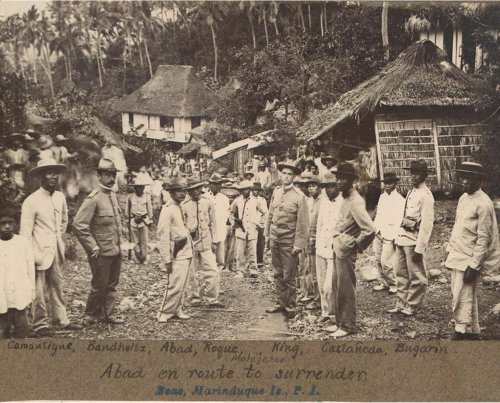
Photo: Abad en route to surrender, Boac, Marinduque Is. P.I.,” from the Harry H. Bandholtz papers ca.1890 - ca. 1937 which are in the repository of the Bently Historical Library, Item No. BL003767 and accessed by the author (Miguel R. Magalang) through umich-bhl-9436 on November 09, 2014, 10:00PM.


Valuable long hours of work have been spent by Konsehal Myke Magalang in researching, compiling and writing "COL. MAXIMO ABAD: Exultations and Twinges in His Life Stories". On the occasion today, Sept. 13, of the Battle of Pulang Lupa, Col. Maximo Abad, foremost hero of the Philippine-American War in Marinduque is once again remembered.

The author, Magalang is the Chairperson of Kilusang Pangkasayayan ng Bayan ng Boac; and Chairperson, Committee on Education, Local History, Culture & the Arts of the Sangguniang Bayan of Boac (2013-2016).

His work with the following Introduction may be accessed here.


INTRODUCTION

The photo above attests to the eminence and prominence that Col. Maximo Abad played in the war for independence by the people of Marinduque during the Filipino-Spanish War and the Filipino-American War, and his post-war achievements, feats and exploits that significantly changed the course of history and story of this Island Province. Eli Obligacion in his blog endeavoured in "Tracing the Footsteps of Col. Maximo Abad”  (Obligacion: 2009) where he mentioned that:

"Lt. Col. Maximo Abad  is probably one of the most elusive among the Filipino soldiers who fought during the Philippine-American War, the hero who led the Marinduque revolutionary forces and defeated the Americans in the “Battle of Pulang Lupa”. During the last four decades after the first commemoration in Marinduque of this, now annually-celebrated event, facts about Abad have remained equally elusive.

"So little is known about him  –  the Maximo Abad who tenaciously adhered to the cause of Marinduque’s defense and Philippine Independence."

As student of history, the author was challenged to also add up to the needed information on Maximo Abad and to fill in the gaps, little by little, on his life story. With the initial information gathered by Obligacion, patience and hard work were employed to look for and gather important information from primary sources of local history and other significant government documents, secondary sources and other references in order to validate the information in his initial research. 

This paper is a work in progress for the last few years. References were compiled since the year 1998 (Philippine Independence Centennial) to give light to the various periods in the life stories of Col. Maximo Abad and other events in the island of Marinduque and the Pueblo of Boac. This aims to provide references to students and teachers of local history so that the future generations will have a fair and better understanding of the lives and contributions of our local heroes, and the events that shaped the historical and cultural development of this Island.  - Miguel R. Magalang, Col. Maximo Abad: Exultations and Twinges in His Life Stories

Also read:

Monday, August 31, 2015

Remembering Col. Maximo Abad on National Heroes Day, Marinduque concentration camps, burning of houses

National Heroes Day in the Philippines (last Monday of August), is a national public holiday to honor and remember the country’s national heroes, both known and unknown whose acts of courage enabled the Philippines to grow as a nation.


Towering among local heroes in the island-province of Marinduque is Col. Maximo Abad, hero of the Philippine-American War, the second phase of the Philippine revolution. Abad led the Marinduque revolutionary forces and defeated the Americans in the "Battle of Pulang Lupa". 
Many historical buffs could easily draw the conclusion that the exploits of the more celebrated national heroes would pale in comparison to the war exploits in that battle of this great local hero.
The most comprehensive account of the U.S. Army's pacification of Marinduque was authored by Andrew J. Birtle and was published in the Journal of Military History 61 (April 1997).
Conclusively in that comprehensive article, Marinduque in those days was where the earliest harsh employment of "population concentration", euphemism for concentration camps, the burning of houses and other forms of violence against men and animals were used as technique to make people subservient to new foreign masters. Shades of this technique are uncannily still employed in this tiny island-province until today - to bring people into subservience as a study of its contemporary political history will show.
The Birtle account begins with the following gripping lines:
“The severity with which the inhabitants have been dealt would not look well if a complete history of it were written out”.  
”So wrote Philippine Commissioner William Howard Taft concerning the U.S. Army's campaign on the island of Marinduque during the Philippine War of 1899-1902. The pacification of Marinduque was characterized by extensive devastation and marked one of the earliest employments of population concentration in the Philippine War, techniques that would eventually be used on a much larger scale in the two most famous campaigns of the war, those of Brigadier Generals J. Franklin Bell in Batangas and Jacob H. Smith in Samar..." 
Taft would later become the Governor-General of the Philippines and later serve as the 27th President of the United States (1909-1913).
But other than the Birtle account, what more do we know about Col. Maximo Abad since very little is known about his life?
A couple of days ago, thanks to the Internet, I have received via this blog additional information from a reader, RA Sor, as comment to an article I wrote five years ago, "Tracing the footsteps of Col. Maximo Abad" which, in the spirit of National Heroes Day, are both reproduced below: 
AvatarRamon L. Abad is half brother of Ramon "Daddy Amon" Sunico, Francisca "Mama Ne" Sunico-Monzon (wife of MLQU founder Chairman and President Leoncio Monzon and Julito Sunico. Consolacion Lozano Abad was married to a Sunico, widowed then married Col. Abad.


    • Avatar


      Colonel Maximo Abad married a Consolacion Lozano (pure Spanish decent daughter of a Galleon Captain Lozano. Colonel Maximo Abad was father to Ramon L. Abad. However he had other issue from other women in his life.

      Col. Abad lived with his family in Pikit North Cotobato, he was an applicant for homesead patent in Pikit, however the Japanese War prevented titling in his name of the land he developed. His lot houses the Municipal Government, School, Church and of late a pineapple farm which operates on his property without the consent of his heirs.
      Documents relative to his ownership over said lot is in Malacanang Library, a case was filed in Pikit with counsel Atty. Benedicto on record.

    TRACING THE FOOTSTEPS OF COLONEL MAXIMO ABAD

    by Eli J. Obligacion

    (Photo: Labanan sa Pulang Lupa dance-drama, 2007, written and directed by Eli J. Obligacion)

    TRACING THE FOOTSTEPS OF COL. MAXIMO ABAD... AND CAPT. TEOFILO ROQUE


    Lt. Col. Maximo Abad is probably one of the most elusive among the Filipino soldiers who fought during the Philippine-American War, the hero who led the Marinduque revolutionary forces and defeated the Americans in the “Battle of Pulang Lupa”. During the last four decades after the first commemoration in Marinduque of this, now annually-celebrated event, facts about Abad have remained equally elusive. 

    So little is known about him – the Maximo Abad who tenaciously adhered to the cause of Marinduque’s defense and Philippine Independence. For one, the name does not appear in the Centennial Resource Book, “Ang mga Bayani sa Ating Kasaysayan” listing of famous and unsung heroes, a project completed in connection with the Philippine Centennial in 1998. 

    The Philippine National Police provincial headquarters in Marinduque is named after him: “Camp Col. Maximo Abad”. Yet, for years the Camp has tried, in vain, to also trace his mother's surname so the initial could be appended between “Maximo” and “Abad” in the welcome signage there.

    Since nothing really appears to have been written about Abad’s background, (except his well-documented exploits in the Marinduque battle), we felt it appropriate to try to dig into some old documents, surf, recollect, and ask around here to trace his steps, to know a bit more about our celebrated hero. After all, August 31 is a holiday for national heroes. 

    Birtle (U.S. Army’s Pacification Campaign in Marinduque, April 1900-April 1901), described him as “a moustachioed school teacher from Luzon’s Cavite province”. We dig up an old Boac fiesta souvenir program with a brief description of the town’s history naming Maximo Abad as a “Maestro” in the first school for boys established there, “Escuela de Nino”, and that he was from Imus. Imus, of course, has always been associated with the resistance movement, and this might explain his early association with Gen. Mariano Trias, from whom he’d eventually be getting orders in the course of his Marinduque exploits. So we’re beginning to find connections. 

    Birtle contends that the civil and military leadership of the resistance movement on Marinduque was firmly rooted in the island's middle and upper classes, and that the insurrection was also in many ways a 
    family affair. 

    The American writer then goes on to tell us that Abad’s brother-in-law, Capt. Fausto Roque commanded the 1st Guerilla, and that Fausto had a cousin, Teofilo Roque (of the Battle of Paye fame whose biography also appears nowhere and likewise, needs to be written for history buffs). Teofilo commanded the 2nd Guerilla. 

    That leads us to the Roque residence in Mercado St., Boac, hoping to find more clues, particularly the name of Abad’s wife and children, if any, because that was our original intent.

    We find that Fausto and Teofilo were cousins, indeed. But at the moment, no one remembers the name of Maximo’s beloved wife. They had a son for sure, we are told, but there's uncertainty if they had other children too.

    We, however, unearth some information about Teofilo, the Paye hero. Teofilo was born in 1873, the son of Tomas Roque*, native of Bulacan, and Juana Navaroso, a local lass from Boac. Teofilo was the third of nine children. He graduated as a law student at Ateneo de Manila, and was still a bachelor in 1898, when he served as Lieutenant in the Marinduque Revolutionary Force.

    By the time the Paye episode transpired he was already married to Filomena “Nena” Morente. The marriage did not produce any offspring. He was 60 when his wife died, then moved to Manila where he died in August 1942 at age 69. That appeared to give us some idea about the Teofilo Roque persona.

    Then we zoom in again on the Abad character, one who has been described as passive, and turn to the internet. 

    Wikipedia credits Abad for being one of Gen. Licerio Geronimo's riflemen in the Battle of San Mateo (erroneously referred in that site and in many other sites as "Battle of Paye"), which occured on Dec. 19, 1899. But since a major confusion has been caused by Wikipedia in calling it by another name, and considering the fact that it was Abad's men who were involved in the real Battle of Paye on July 31, 1900, in Boac, Marinduque (led by Capt. Teofilo Roque), we'll have to consider it a confused claim unless backed up by verifiable references.

    We then discover the text of a Supreme Court document dated Oct. 22, 1902, that showed Abad was earlier charged and convicted for having denied to an officer of the U.S. Army the existence of certain rifles which had been concealed at the time of his surrender in April 1901. It appears that he appealed the conviction and the Supreme Court held that the violation committed by the appellant Abad falls within the scope of “treason” and “sedition” and covered by the amnesty proclamation. The Court decided that Abad was entitled to the benefits of the proclamation and ordered that he be discharged
    .
    The Maximo Abad surrender photo. Abad is accompanied in this photo by his comrades who had earlier surrendered, and by Col. Harry Hill Bandholtz of the Philippine Constabulary.

    So, this shows that the Americans pulled one over him after having dangled the carrot that ensured fair treatment if he surrendered. He did surrender on April 15, 1901, at Boac’s town plaza in an impressive ceremony attended by the townspeople.

    We then come across other leads, chancing upon a listing of municipal heads in Imus from 1888 to the present which showed an entry: “Maximo Abad (1910-1912)”. That appears to tell us that our man returned to Imus and even became its mayor eight years later.

    What happens next? A passage from Cotabato’s history states a new twist, thus:

    “The first Christian settlers in Cotabato from outside of Mindanao, mostly coming from the province of Cebu, arrived in Pikit on June 17, 1913 at the behest and as a result of the efforts of the late President Sergio Osmeña, who was then the Speaker of the Philippine Commission. Expenses of their transfer to the "Land of Promise" were subsidized by the government. The administrator of the colonies given to the settlers at that time was a superintendent by the name of Maximo Abad, a government appointed official, who took care of the settlers’ needs like food and farm implements. There were six more batches of colonies that arrived thereafter...”

    It therefore appears that the adventurous spirit of Abad never waned and he journeyed to a vaster frontier that imposed bigger challenges.

    Col. Maximo Abad

    Finally, we find something as we come across a site attempting to trace genealogies:

    “Col. Maximo Abad (deceased) Husband of unknown and Consolacion; Father of Ramon Lozano Abad and Josefina”

    And related information stating that “Ramon Lozano Abad” was “Half-brother of Ramon, Francisco and Julito”

    Fresh leads. He appears to have remarried and raised more children, and three appear to be half-brothers. In time, someone might prove instrumental when we finally gain access to the Revolutionary Papers tightly guarded within the confines of the National Archives.

    It's not an easy task to put it all together. But we're seized by the inescapable feeling that tracing the paths of an elusive person brings. We feel it's a good start. A great National Heroes Day for me, I might say.


    Sources:
    (*Tomas Roque (Dec. 29, 1841-June 6, 1907): Boac Gobernadorcillo from 1877-1979 and 1897-1898. Helped in the local distribution of Rizal’s “Noli Me Tangere” and “El Filibustrismo” together with Marcelo Mirafuente of Boac; was authorized by Gen. Emilio Aguinaldo in 1898 to recruit and train soldiers who eventually figured in the Paye and Pulang Lupa battles. “Tomas Roque Street” in Boac named after him.
    Source: Document from granddaughter Juanita Roque-Enriquez as told by Joaquin Roque, a son of Tomas Roque)

    The Journal of Military History 61(April 1997) The U.S. Army's Pacification of Marinduque, Philippine Islands, April 1900-April 1901 by Andrew J. Birtle.
    Interview with Mrs. Fe Corazon Enriquez-Recalde. She supplied documents on Teofilo Roque prepared by her mother, Juanita Roque based on an account by Joaquin Roque, a brother of Teofilo.

    http://www.wowphilippines.com.ph/explore_phil/place_details.asp?content=history&province=61
    http://www.msc.edu.ph/centennial/hero/bicol/page10.html
    www.en.wikipedia.org
    www.ulongbeach.com
    www.gini.com

    Libingan ng mga Bayani in Fort Bonifacio figures in today's commemoration.
    Now where's Col. Maximo Abad's resting place?