Showing posts with label Maniwaya. Show all posts

Friday, October 26, 2018

With Polo Island fully powered, the popular Maniwaya to also enjoy uninterrupted power supply.

The second of a 3-phase submarine cable in the Sta. Cruz islands begins. Photo shows Cong. Lord Allan Velasco (Marinduque) with officials of the National Electrification Administration, Marinduque Electric Cooperative and AsiaPhil.

Yesterday, Oct. 25 the Ground-Breaking Ceremony for the construction of a 3-phase submarine cable connecting the islands of Polo and Maniwaya in Sta. Cruz took place in the barangay island of Maniwaya. 


Cong. Lord Allan Velasco graced the occasion together with officials of NEA, Marelco and AsiaPhil. This is a project of the National Electrification Administration (NEA) that was funded through its Barangay Line Enhancement Program (BLEP).

In summer tourists pitch tents near the beaches.

Maniwaya is a popular tourist get-away island located at the northeastern coast of Marinduque. Positive social media feeds have greatly influenced travelers to experience this island that boasts of white sand beaches, a fascinating sand-bar, small inexpensive resorts and friendly people.

Ground-breaking with Cong. Velasco
Photo: Batuskie Reynes

It will be recalled that on February 9, 2018, a switch-on ceremony was held in the quiet white-sand barangay island of Polo, the Sta. Cruz island closest to the Marinduque mainland. That was for the first-ever installation of a submarine cable connecting Polo Island to the Marinduque main grid.

Currently Polo Island is enjoying an uninterrupted 24/7 power supply.

After Maniwaya has been fully powered, slowly but surely Mongpong Island comes next.

Front page of a Philippine Daily Inquirer issue with the Ungab Rock Formation in Mongpong Island, Sta. Cruz, Marinduque

...then they came!

Monday, May 5, 2014

Inquirer visits Marinduque's 'palm of the ocean'

Marinduque: Visiting the ‘palm of the ocean’

By ,

NATURAL BRIDGE The bridge formed by the Ungab rock formation on Mongpong Island in Marinduque province towers 100 feet above the water. RAFFY LERMA

STA. CRUZ, MARINDUQUE, Philippines—It could be a tricky trip down the island village of Maniwaya to a favorite destination: the Palád sandbar. 

It is not clear how the patch of white earth, inescapable in the glass-like, bluish-green waters, got its name. 

One resident said it may have gotten its name from palad, the Filipino word for palm, since it looks like an open palm of the hand. Another likened it to a plate of bibingka, the white and flat Filipino rice cake, floating on the water. 

So imagine yourself tripping and tiptoeing on the palm of the ocean—if nature is kind enough to open its hand. 

The tricky part in going to Palád is the timing. Palád “surfaces” and becomes visible only during low tide, and “disappears back into the water,” as residents put it, as the tide grows higher throughout the day. In full view, the sandbar emerges 50 meters long and about 20 to 25 meters wide. 

Timing
 
“It should be visible any time of the year but only during the early hours, somewhere between 5 a.m. to 6 a.m., and again in the afternoon from 4 p.m. to 6 p.m.,” said Maniwaya village captain Francisco Principe. Some residents, however, observe a longer period of low tide during the months of December to February and believe that chances of seeing the sandbar are greater then. 

But even this is not an assurance that the sandbar would show itself. When the Inquirer visited the island one April morning, the water on Palád was waist-high. We had to plant our feet firmly on the white, fine sand lest the current carry us to the deeper portions of the sea. 

“What I like here most is that the water’s clean, there’s no pollution and it’s not crowded,” said Jastin Cortez, 23, a first-time tourist on the island. He said he was invited to Palád by his cousins on Maniwaya. 

Maniwaya Island
 
Maniwaya (land area: 1,300 hectares; estimated population: 1,500) is the second of the three island villages of Sta. Cruz town when traveling from mainland Marinduque province. Like the other two—Polo and Mongpong (also spelled Mompong)—villagers rely mainly on farming and fishing.
Household water is sourced from deep wells or the rains. The power supply is available from 5 p.m. to 11 p.m., except for a few homes that have installed solar panels. A mobile phone signal is not always reliable and, of course, there is no Internet connection available. 

But Maniwaya’s 2-kilometer white sand beach is slowly, and steadily, capturing Manila’s attention, mainly through word of mouth, social media and the travel blogs of visitors. Principe said the island’s annual local income had increased from P1.2 million a few years back to P1.7 million when local and foreign tourists started coming in. 

Maniwaya is also, by far, the most developed of the three islands if gauged by resort and accommodation facilities, particularly on the island’s eastern side. For one, there is the Residencia de Palomaria hotel and resort (room rates start at P2,000 to P2,500), which offers tour packages and water sports facilities, and about nine other smaller beach resorts (estimated room rates: P1,500). 

Ungab rock formation
 
If you miss Palád, don’t worry. There are other sites to complete the island hopping. 

There is Polo Island, the first that comes into view from Buyabod port. Polo Island, though, is not ideal for beach bummers. 

“The water in Polo is just as pristine but you can [feel] a bit itchy because of the mangroves,” Principe said. According to the Marinduque environment office, most of the island, or about 200 ha, is planted with mangroves. There is not a single beach resort on Polo but it is a prized view for nature-trippers. 

From Maniwaya, the Ungab rock formation on Mongpong Island is definitely another site worth visiting. The cove located in Sitio Ungab boasts of an overarching rock formation that towers about 100 feet above the water. Read more on INQUIRER

Tuesday, December 18, 2012

Youth leaders meet in Maniwaya Island

 Youth leaders from the different barangays in Marinduque's six municipalities hold team-building exercises at Maniwaya Island in Sta. Cruz last Sunday. A huge number of them were on this peaceful island of white sand beaches for the first time. Volunteers from JCI Marinduque facilitated the exercises. 

Sun sets in Sta. Cruz.

The campers pitched their tents right beside the cottages but spent most of the night outside singing, cheering and sharing their stories.

Extreme blue sky, clouds in a distance, extremely low tide, swimming had to wait.

Time to play with water.

Monday, October 15, 2012

One paradisical island in Marinduque

Get away from the hustle and bustle of the big city.
Come to Marinduque and discover the lesser known paradisical islands
north, south, east and west of it.

One of them north-east is called Maniwaya in Sta. Cruz.
Maiwaya's beaches are covered with powdery white sands.

There you could go around on a delightful walk by yourself or with a dear one,
find a corner and bask in the pleasant warmth of the sun to ponder eternity.

There is a small resort in Maniwaya you could check out.

Monday, June 18, 2012

Palo Maria de la Playa immortalized

Palo Maria (or Palo Maria de la Playa –Calophyllum inophyllum; is also known in Tagalog as Dangcalan).It grows in Marinduque and throughout the Philippine archipelago, along the seashore and is cultivated as shade tree on lawns, avenues and boulevards particularly along the beach.


palomaria2
Palo Maria has many uses in herbal medicine, such as crushed kernels applied to abdomen for gas pains and indigestion, its oil also used as external application for indigestion and colic. In Hawaii, bark resin is used for ulcers; In Java, used for its diuretic properties; In Fiji, leaves are used as lotion for sore eyes; in Samoa leaves are used for skin inflammations, leg ulcers and wounds; in India leaves are used for migraines, vertigo, ophthalmia. There are existing and continuing studies on its medicinal uses.

palomaria3
The wood is greatly appreciated for crooks and curves (bends or angles), but is also used for large vessels. Due to the absence of acrid juices, iron bolts do not corrode in it. It is exceedingly tough and not so heavy as Molave.

palomaria4
The leaves are shiny and leathery, the flowers are fragrant.
Fruit is round, yellow and pulpy. 

palomaria5
Palo Maria tree reaches a height of 20 meters. Check your Marinduque beach property for these trees. Nice to plant more Palo Maria, alongside Dita and Talisay that grows more easily. Then when you get next time to where the Palo Maria name has been immortalized, check if it still survives along the beaches there - in Maniwaya.

dita
Dita grows side by side with Palo Maria.

talisay
The ubiquitous Talisay tree found along the beaches of Marinduque.

Saturday, June 16, 2012

Leave nothing but footprints on the beaches


And when you walk through the glistening white sand beaches of Maniwaya in Sta. Cruz and the other islands of Marinduque, be aware. You also have a responsibility to be an active steward of the environment.

The Footprints Project was started out by a few Filipino friends who enjoyed travelling so much, they were compelled to write about their trips until it dawned upon them that they could do more by helping increase awareness about responsible travel, providing tips and insights and learning from their readers.


While pushing for beach tourism in the Philippines, the group is keenly aware of the danger that tourism could also bring destruction and therefore, tourists must be well equipped with enough information before they set out to explore and enjoy the beaches. And so, for travelers to take seriously the saying "leave nothing but footprints".

This group of friends actively share their love for travel and the beaches in the social media. Their website is PhilippineBeaches.org.


Footprints Project's reasons for being:


"Tourism brings pleasure. Most tourists travel to relax, unwind and enjoy. The mere sight of the beach inspires ideas and enables us to see things differently. The sound of the waves hitting the shore allows us to escape the pressure and violent jolts of metropolitan living. The activities that await us on the beach are opportunities to build and strengthen relationships. These benefits are exactly what we would like to share with everyone by showcasing the beauty and wonder of our islands and pushing travel packages that are not just enjoyable but easily affordable.


"Tourism brings jobs and livelihood to communities
. We have seen tourism change the lives of the people residing in coastal areas and help save the environment. Fishermen in some parts of the country who used to hunt down and kill whalesharks have now become tour guides and guardians of the threatened species. Dynamite and cyanide fishing in some areas decreased significantly when fishermen learned that bringing tourists to beautiful spots makes more money than killing wildlife. These fruits of tourism will be enjoyed by many other communities throughout the country.


"Tourism, however, also brings destruction
. We've seen many beaches get abused and exploited by both residents and tourists themselves. This is why we also spread the word on the many ways on how to minimize footprints. Tourists must be equipped with enough information on responsible travel before they go out there and explore."

Friday, June 15, 2012

Residencia de Palo Maria: Newest Marinduque resort address

They’ve opened it! The place to go to in Marinduque if you're looking for a place to sneak away to for a couple of days, where you could instantly feel not that many souls have walked along the long stretch of glistening white sand beaches you see, right before your very eyes. 


The place to be, if you want to get away from it all to an island you feel more remote, with no loud partying to distract you, where you have the choice of just sipping your favorite beverage by the quiet pool while following the story you’re reading, or go snorkeling on your own, or when you suddenly feel adventurous -  the jetskis are there, anyway.


And this is it!
RESIDENCIA DE PALO MARIA (MANIWAYA HOTEL and BEACH RESORT)

(Above photo from http://flavorsoflife.com.ph/?p=322 that also shares a unique
Palo Maria, Maniwaya Island and Sta. Cruz experience)
I just suppose you wouldn’t feel like royalty there, it may not be classified luxury as yet,
but it is a luxury getaway for those who can’t afford multiple star getaways.

Family Room: Php 2,500 - Overnight stay/24 hrs (Min. 4 pax/max 7 pax)
Additional Php 200 per bed/person. W/ Aircon, TV w/ Cable and Ref
Twin Bungalow Room. Php 2,000 - Overnight stay/24 hrs (Min. 4/Max 5 pax)
Additional Php 200 per bed/person. W/ Aircon, TV w/ Cable.

Kubo/Bamboo Hut. Php 1,500 - Overnight stay/24 hrs (2-3 pax)
W/ Fan and TV.

Palo Maria Sandbar. Got to be there!

Photo credits: Residencia de Palo Maria

Thursday, May 17, 2012

More fun in Maniwaya Island

One of the developing resorts at Maniwaya Island in Sta. Cruz, Marinduque. Maniwaya attracts local tourists because it is the island closest to Manila with powdery white sand and is just there waiting for anyone who likes quietude.

How do you get to Maniwaya? In this case, this small group took a pump boat at Buyabod Port, also in Sta. Cruz, to get to Maniwaya


They finally come this close to the island after one hour and a half of boat ride.

Here beckons Maniwaya's white sand beach, with the mountains of Sta. Cruz in the background.

The group is greeted by these cottages, one of few private places on the rise in Maniwaya.

They could hardly wait and at once took to the water.

Pretty girl stayed ashore to cook some fish. Her name is Pretty, anyway.

Tong-its after swimming as the sun's too hot daw for their skin, sabi ha.

Later Kryx decides he's had it and off he goes to explore other parts of the island. 

Group excitedly discovers a fast developing resort, called Residencia de Palo Maria - with cool, cozy cottages and a swimming pool still being constucted.

Kryx happily finds a unique duyan, swing in the Palo Maria resort premises.

He also discovers a jetski, tries it.

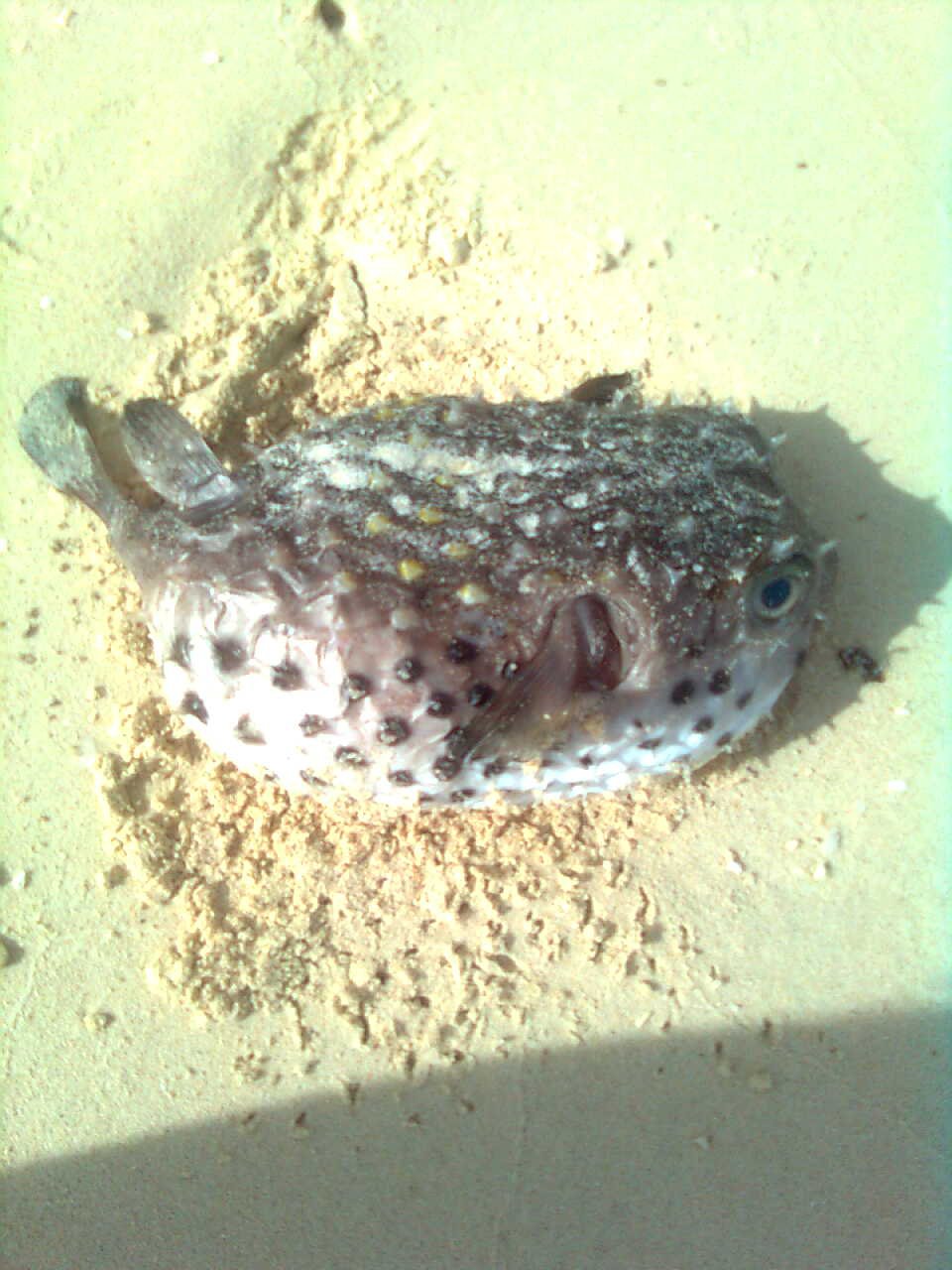
He also comes across this small, spiny, creepy globular animal...

Later, the group had more fun playing with the sand..

Another strange creature found on the beach...
Close towards sunset, they start having shots of Emperador.

Sunset over Pulo Island just across Maniwaya.

 And darkness creeps in.